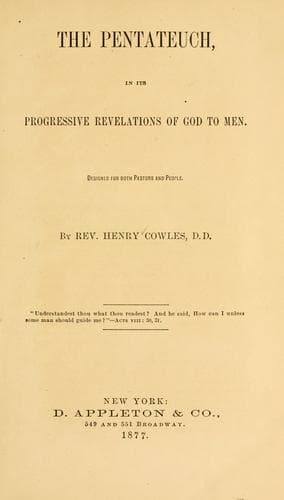
The Pentateuch, in Its Progressive Revelations of God to MenCowles, Henry
Religion
The Pentateuch, in Its Progressive Revelations of God to Men
Cowles, Henry
Bible. Pentateuch -- Criticism, interpretation, etc.
Here, strange to say, some good men would thrust in a peremptory
limitation, asserting that this family covenant is Abrahamic and Jewish
only; good for them, but not good for the Christian age; good in the
national but not in the family sense and application thereof.――――But
what is the logic of such a limitation? Was the love of parent for
offspring lost out of the human heart at the coming of Christ? Or
did the Lord forget at that point how deeply he had implanted this
love in human bosoms? Or did he think that piety, under the improved
auspices of the gospel age, could thrive without the help of this
family covenant? Or did he reason thus――that the gospel age having
the advantage of the Jewish in so many points, could afford to forego
this family promise, and yet not on the whole fall below the Abrahamic
dispensation?――――Or in another point of view, looking at the evidence
rather historically than logically, it is claimed, as I understand the
argument, that Christ did not renew the promise――“A God to thee and
to thy seed after thee”; and therefore it did not pass over into the
gospel age.――――To which I reply; The real question is――not, Did Christ
_renew_? but, Did he _annul_? Did he say――I have come to make void
the law, not to fulfill? Did he say――That family covenant which the
patriarchs loved so dearly, in the faith of which they trained their
sons and daughters into the love and service of their fathers’ God, has
well done its work and can stand no longer? Did he labor to reconcile
the parental heart of his Jewish disciples――loving their dear little
ones so tenderly――to this sudden withdrawal of divine promise――to
this sore bereavement of hope and slaughter of faith? Was this what
he meant when he said; “Suffer the little children to come unto me
and forbid them not; for of such is the kingdom of heaven”? Or was
this the meaning of Peter when in the first Pentecostal sermon he
proclaimed――“The promise (of the Holy Ghost) is to you _and to your
children_” (Ac. 2: 39)? Or could this have been the purpose of Paul
when he testified; “If ye be Christ’s, then are ye Abraham’s seed
and heirs according to the promise” (Gal. 3: 29)?――――The proof that
the gospel age ruled out the great family covenant is by no means
apparent.――――It should be considered that the covenant is one thing;
circumcision another. The covenant does not of necessity die because
circumcision is discontinued. The covenant existed before circumcision
and could be operative without it; indeed could live without any
visible sign or seal, if so the Lord pleased.――――Nor does the
perpetuity of this covenant turn on the proof that baptism takes in
all respects the place of circumcision. Whether it does fill the same
place or does not, the covenant standeth sure. There is value in an
external rite or seal――else God had never enjoined it. But it falls
exceedingly far short of being the thing of chief value.
Public-domain text, read in full here on John Shaqi.
Reviews
Reviews
No reviews yet
Be the first to share your thoughts on this work.
Elsewhere in the archive
Join the Discussion
Join the discussion
Sign in to leave a comment or review.
Sign InorCreate an account