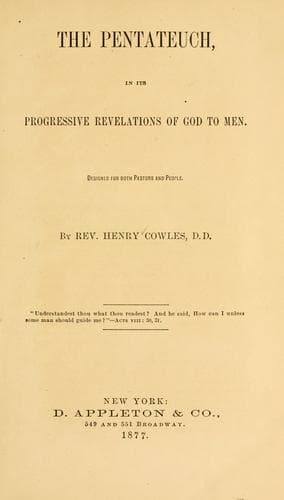
The Pentateuch, in Its Progressive Revelations of God to MenCowles, Henry
Religion
The Pentateuch, in Its Progressive Revelations of God to Men
Cowles, Henry
Bible. Pentateuch -- Criticism, interpretation, etc.
Into the argument respecting the change from the old seal to a new one,
it is not in place here to enter.
This class of moral sentiments and social affections looks _forward_
in the line of human generations from parent to offspring. Another
class of no small value looks _back_ reverently, not to say proudly, to
_honored ancestors_. Here also Abraham’s name became a positive power
upon his posterity――not indeed of the very highest efficiency――not
altogether proof against being corrupted to the pampering of national
pride and even of personal self-righteousness, for bad men might learn
to say, “We have Abraham for our father.” Yet still it can not be
questioned that for long ages the name and history of Abraham bore the
precious savor of his faith and of his staunch fidelity as the servant
of the living God. It was the prestige of a name both great and good,
and served to perpetuate his piety among millions of his offspring.
In this direction all those qualities in Abraham which made him truly
great as well as eminently good become elements in this new scheme
for augmenting the spiritual and moral forces of God’s kingdom among
men.――――It can not be amiss, therefore, to linger here a moment and
study this wonderful man. Verily the Lord found the right man for his
purposes in Abram, then living in “Ur of the Chaldees.” He called him
to leave kindred (save the few who joined him in this migration); to
leave also all there was to him in country――the land of his fathers’
sepulchers; and travel several hundred miles to a strange unknown
land. Abram heard and recognized God’s voice; he bowed to his authority
and went. This first recorded illustration of his faith in God and
obedience made its impression upon future ages――as we may see in the
words of Joshua (24: 2, 3); of Nehemiah (9: 7, 8); of Stephen (Acts
7: 2–5); and of the writer to the Hebrews (11: 8–10)――which last may
be taken as a specimen of all. “By faith Abraham, when he was called to
go out into a place which he should after receive for an inheritance,
obeyed; and he went out, not knowing whither he went.”
Not a little might be said of many of the lesser yet really noble
qualities of Abraham’s character――how magnanimous he appears in his
bearing toward Lot (Gen. 13: 5–9); how dignified before the sons of
Heth (Gen. 23: 3–16); how hospitable in entertaining three strangers
who came up as he sat in his tent door in the heat of the day (Gen. 18:
1–16) when he “entertained angels unawares” (Heb. 13: 2); how humble,
reverent yet earnest in his intercession for Sodom (Gen. 18: 23–33);
how fearless, daring and wonderfully efficient in the rescue of Lot
from the plundering hordes of the East (Gen. 14: 13–24); how unselfish
in refusing to participate in the recovered booty:――but all these
qualities fade like stars before the sun when seen in the presence of
his wonderful faith and unflinching obedience to the commands of the
Lord his God.
Public-domain text, read in full here on John Shaqi.
Reviews
Reviews
No reviews yet
Be the first to share your thoughts on this work.
Elsewhere in the archive
Join the Discussion
Join the discussion
Sign in to leave a comment or review.
Sign InorCreate an account