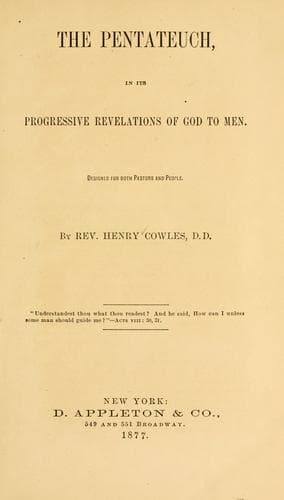
The Pentateuch, in Its Progressive Revelations of God to MenCowles, Henry
Religion
The Pentateuch, in Its Progressive Revelations of God to Men
Cowles, Henry
Bible. Pentateuch -- Criticism, interpretation, etc.
Was Abraham shocked? Did he stagger under this stunning blow? Did he
pause to debate the matter with God? Did he beg that the awful agony
might be at least delayed till he could collect himself and prepare
for a trial so unexpected, so sudden, so terrible to bear? The record
gives no hint of any thing of the sort. Abraham had heard God’s voice
many times before and could not have had the first doubt as to its
identity. If the least doubt had crossed his mind he surely would have
said――“Lord, this seems so unlike Thee: Is it not Satan, thine enemy?
I can not move one step until I know of a certainty that this is thine
own voice.”――――But there was no relief in this direction. Yet we almost
instinctively ask――Did not Abraham expostulate? Did he not say――O my
Lord, this Isaac is the son of thine own promise, my only hope for
that great and long promised posterity; and what wilt thou do for _thy
truth_? Besides, the deed is so shocking, so revolting to a father’s
heart! Moreover, hast thou not said――“Whoso sheddeth man’s blood, by
man shall his blood be shed”? And what an example this will be before
all the tribes of the earth! How it will encourage them on to murder
their children in sacrifice to their gods!
We can readily make up what may seem to us very strong arguments
against obedience to such a command; but it does not appear that
Abraham whispered in his heart the first one of them. The only hint
we have of his deep thoughts in the case comes through the writer to
the Hebrew Christians――“Accounting that God was able to raise him up
even from the dead.” Plainly the Lord meant to show that his command
when made known unquestionably is to be obeyed without debate――with
no misgivings, no faltering, no fear. So Abraham moved firmly on,
saying not a word to Sarah, keeping his counsel even from his two
chosen servants and from his son; holding the strange secret in his
solitary――shall we say, _sad_ bosom?――――No; for there is not the first
note of sadness throughout this wonderful transaction. Look at those
three days of ongoing journey. Ah, was not this a long time to think
over the strange deed! And those intervening nights――was there any
sleep to his eyes while this terrible suspense lay still between the
command and its execution?――――So far as appears Abraham moved on with
unshaken fortitude and undisturbed calmness. Certain it is that he
never lost his self-possession, for he continued to plan carefully
and even sharply against disturbing influences. He could not trust his
servants to stand by; so he halted them at a distance back from the
scene. He kept the awful secret from his son Isaac until he had him
bound and laid on the altar and the uplifted blade was ready to fall!
Public-domain text, read in full here on John Shaqi.
Reviews
Reviews
No reviews yet
Be the first to share your thoughts on this work.
Elsewhere in the archive
Join the Discussion
Join the discussion
Sign in to leave a comment or review.
Sign InorCreate an account