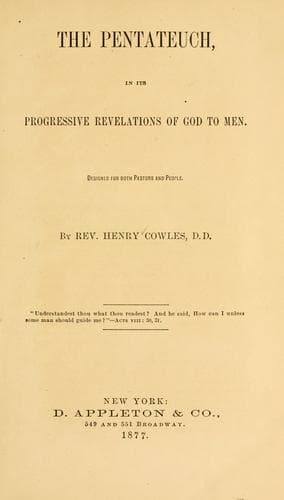
The Pentateuch, in Its Progressive Revelations of God to MenCowles, Henry
Religion
The Pentateuch, in Its Progressive Revelations of God to Men
Cowles, Henry
Bible. Pentateuch -- Criticism, interpretation, etc.
This was the obedience of faith! The wonderful illustration stands
out before all the ages with God’s seal of approbation broadly stamped
upon it.――――When the trial had fully reached its culminating point
and no room remained for doubt that Abraham would obey God at every
cost, fearless of consequences, or rather committing all consequences
to his God, then God’s angel interposed! A ram was provided for the
sacrifice and the son of promise went back to a more happy home with
a more happy father, doubly blessed in the renewed approbation of his
covenant-keeping God. No wonder that God proceeded then to make that
covenant stronger and broader and richer than ever before! No wonder
Abraham stamped into the very name of this ever memorable locality one
of the grand moral lessons of the scene――“Jehovah Jireh”――_In the mount
of the Lord, himself will provide!_ When you come to the mount of last
and utmost emergency, the Lord will have salvation ready! His angel
will appear; the ram of sacrifice will be there; and Isaac may go in
peace!
* * * * *
According to the common law of Christian experience, God’s methods
with Abraham were _progressive_; his manifestations of himself moved on
by successive stages; much this year but more the next; so much indeed
at the first that it must have seemed to the good man very great, but
more and greater were yet to come. The successive epochs at which God
appeared to Abraham to talk with him of the great covenant are very
distinctly marked in the history――of such sort as many a Christian
might record in his own personal life-history.
1. In the outset of Abraham’s history is that eventful _call_ which
brought him out from “Ur of the Chaldees,” the narrative of which
stands Gen. 12: 1–3. In the promise made to him then the leading
points were――“I will make thy name great”; “I will make of thee a great
nation”; “thou shalt be a blessing and in thee shall all the families
of the earth be blessed”; I will stand by thee to bless all who bless
thee and to curse whosoever may curse thee.――――This must have raised in
Abram’s mind large expectations and assured him that Jehovah was indeed
his own God.
2. Immediately after Abram’s arrival in Canaan (Gen. 12: 7) the Lord
appeared to him specially to identify that as _the_ land which he had
promised (Gen. 12: 1) to show him and to give to his posterity. There,
as in each new home, Abram built an altar and in devout worship called
on the name of the Lord who had thus appeared to him.
Public-domain text, read in full here on John Shaqi.
Reviews
Reviews
No reviews yet
Be the first to share your thoughts on this work.
Elsewhere in the archive
Join the Discussion
Join the discussion
Sign in to leave a comment or review.
Sign InorCreate an account