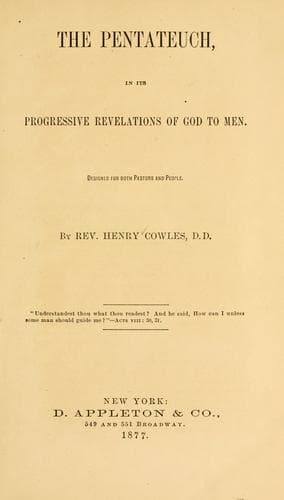
The Pentateuch, in Its Progressive Revelations of God to MenCowles, Henry
Religion
The Pentateuch, in Its Progressive Revelations of God to Men
Cowles, Henry
Bible. Pentateuch -- Criticism, interpretation, etc.
It must be held therefore that the promises made to Abraham really
include a prophecy of Christ. We could not infer from the record in
Genesis how well Abraham understood the reference to the Messiah. But
the allusions to this point in the New Testament give us light, our
Savior most distinctly declaring――Abraham rejoiced that he might see
my day; _he saw it_――with great joy. The writer of the Epistle to the
Hebrews, speaking of Abraham and the patriarchs as not having received
the promised blessings but as seeing them from afar and embracing them,
has in mind specially their faith in the promised heavenly city (Heb.
11: 10, 13, 14, 16), yet not to the exclusion of him who prepares those
mansions for his people (Jno. 14: 2, 3). His testimony is in point to
show that Abraham looked beyond the earthly side of those blessings to
the heavenly; rested not in the earthly Canaan, not in the multitude of
his lineal sons and daughters; but reached out beyond these to the city
that hath eternal foundations and to the blessings of the Great Messiah,
good for all the nations of the earth. The nearer and lesser blessings
had a power of suggestion, lifting his thought to the more remote and
greater. A man who talked with God so intimately can not be supposed
to have missed these grand ideas of the gospel age and of the heavenly
state which we are sometimes wont to regard as the special, not to say
exclusive, revelations of the New Testament.
_Sodom and Gomorrah._
Involved in this history of Abraham, there occurs this ever memorable
case of sudden and most fearful judgment upon the ungodly in this
world――the overthrow of the cities of the plain. Sodom and Gomorrah
only are mentioned by name in Gen. 13: 10 and 19: 24, 28); in several
cases for brevity, Sodom only; but Moses (Deut. 20: 23) and Hosea
(11: 8) speak of Admah and Zeboim as also overthrown. These were
contiguous and (in Gen. 14: 2) confederate cities. The narrative
sets forth their appalling and absolutely universal wickedness. Other
references suggest the causes or occasions (Ezek. 16: 49, 50), and
intimate that the better life and the reproving testimony of Lot were
powerless (2 Pet. 2: 7, 8).
The narrative also makes prominent the immediate agency of God in this
destruction. “The Lord rained upon Sodom and upon Gomorrah fire and
brimstone from the Lord out of heaven” (Gen. 19: 24). “When Abraham
looked toward Sodom and all the land of the plain, lo, the smoke of
the country went up as the smoke of a great furnace” (v. 28).
Public-domain text, read in full here on John Shaqi.
Reviews
Reviews
No reviews yet
Be the first to share your thoughts on this work.
Elsewhere in the archive
Join the Discussion
Join the discussion
Sign in to leave a comment or review.
Sign InorCreate an account