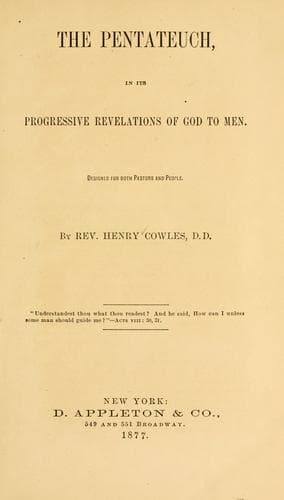
The Pentateuch, in Its Progressive Revelations of God to MenCowles, Henry
Religion
The Pentateuch, in Its Progressive Revelations of God to Men
Cowles, Henry
Bible. Pentateuch -- Criticism, interpretation, etc.
The substance of the prophecy is in the words――“In thy seed shall all
the nations of the earth be blessed” (Gen. 22: 18 and 26: 4). Beyond
question this _may_ include the Messiah as the author of these really
universal blessings――blessings for all the nations of the earth. Nay
more; the blessings are too great, too broad, too far reaching to admit
any supposable interpretation short of the Messiah and the gospel age.
Historically no fulfillment less broad than the Christian can possibly
be made out. In Christ and in him only can this prediction be fulfilled.
And to crown all, our Lord himself testifies; “Your father Abraham
rejoiced to see my day; and _he saw it and was glad_” (Jno. 8: 56). It
may be noticed that the word used by our Lord was not _me_, my person;
but “my _day_”――the gospel age; the great events of it; the wonderful
results of my coming――which is no doubt the exact truth. It was rather
what was to be achieved by Christ in the way of blessings upon all
the nations than what lay in Christ’s _person_ definitely that Abraham
prophetically saw.
Paul adds his testimony that these words refer to Christ;
(a.) Affirming (Gal. 3: 8)――“The Scripture, foreseeing that God would
justify the nations [‘heathen’] through faith, preached before the
gospel to Abraham, saying, ‘In thee shall all nations be blessed.’”
“Preached before” is simply predicted, revealed by prophecy, with the
accessory idea that the thing revealed was the gospel, the news of
salvation.――――(b.) To show that in his view the burden and fullness
of this prophecy are Christ and nothing less or other than Christ, he
says in this connection (v. 16); “Now to Abraham and to his seed were
the promises made. He saith not――And to _seeds_ as of many, but as of
one――And to thy _seed_, which is Christ.”
Waiving any special effort to justify Paul’s argument from the singular
number of the word “seed,” his testimony is certainly valid to the
point for which I have adduced it, viz. that Paul saw Christ in this
prophecy. How much soever the principles of exegesis may reluctate,
they certainly will not deny that he interprets the prophecy concerning
Christ. Their complaint would be that he ties it down to Christ too
exclusively.
Public-domain text, read in full here on John Shaqi.
Reviews
Reviews
No reviews yet
Be the first to share your thoughts on this work.
Elsewhere in the archive
Join the Discussion
Join the discussion
Sign in to leave a comment or review.
Sign InorCreate an account