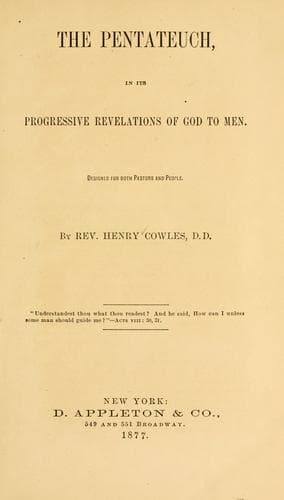
The Pentateuch, in Its Progressive Revelations of God to MenCowles, Henry
Religion
The Pentateuch, in Its Progressive Revelations of God to Men
Cowles, Henry
Bible. Pentateuch -- Criticism, interpretation, etc.
Cases occur in Old Testament history in which the Lord appears in
visible form and is called interchangeably “the Lord” and “the Angel
of the Lord.” See the personal history of Hagar (Gen. 16: 7, 13); of
Abraham (Gen. 18: 2, 16, 33 and 22: 11, 15–18); of Jacob (Gen. 31:
11–13, 16); of Moses (Exod. 3: 2, 4, 6, 7, etc., and 23: 20–23); of
Gideon (Judg. 6: 11, 12, 14, 20–23) and of Manoah (Judg. 13: 18, 22).
The term “angel” means in general a messenger; but is manifestly
applied and therefore is applicable to the visible manifestations of
God himself, supposably of the second person of the Godhead, _i. e._
God as made manifest to mortals. The cases above referred to are
entirely decisive as to the usage of the phrase, “The Angel of the
Lord” in some cases (not relatively many) to denote the very Presence
of the Lord himself coming down to reveal himself to his people. In Gen.
18: first three men appear before Abraham; he entertains them. Two of
them go on toward Sodom; one remains talking with Abraham. It is said
“Abraham stood yet before the Lord”; then drew near and offered that
remarkable prayer of intercession for Sodom; after which “the Lord went
his way and Abraham returned to his place.”――――In Gen. 22, when Abraham
had stretched forth his hand to slay his son, “the angel of the Lord
called to him out of heaven.” Shortly after (vs. 15–18) “the angel of
the Lord called unto Abraham out of heaven the second time and said, By
myself have I sworn, saith the Lord; etc.... Because thou hast obeyed
my voice.” This can be no other than the very God.――――The passages
above referred to from the history of Moses are striking. In Exod. 23:
20–23 we read: “Behold I send an angel before thee to keep thee in the
way and to bring thee into the place which I have prepared. _Beware
of him_” (_i. e._ not to offend him) “and obey his voice; provoke him
not; for he will not pardon your transgressions, for _my name is in
him_”――name, as usual in the sense of the very qualities of character
of which the name is a significant indication.
CHAPTER XI.
THE PATRIARCHS.
_Isaac._
Public-domain text, read in full here on John Shaqi.
Reviews
Reviews
No reviews yet
Be the first to share your thoughts on this work.
Elsewhere in the archive
Join the Discussion
Join the discussion
Sign in to leave a comment or review.
Sign InorCreate an account