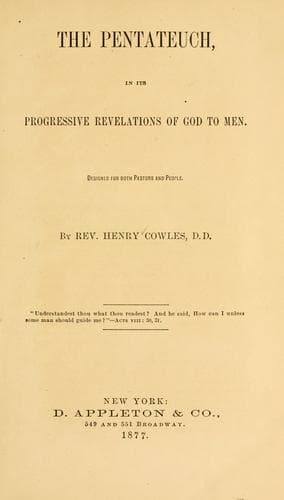
The Pentateuch, in Its Progressive Revelations of God to MenCowles, Henry
Religion
The Pentateuch, in Its Progressive Revelations of God to Men
Cowles, Henry
Bible. Pentateuch -- Criticism, interpretation, etc.
THE story of Isaac is brief; his life uneventful, perhaps we might
say monotonous. The record shows that the Lord appeared to him on two
distinct occasions; at Gerar (Gen. 26: 2–5), renewing the covenant
previously made with Abraham, with a very full restatement of all its
salient points; also at Beersheba (26: 23–25) where we are told “he
builded an altar and called on the name of the Lord,” in the steps
of his godly father.――――We see a point of his character in the fact
stated incidentally, that Esau’s marriage into Hittite families “was
a grief of mind to Isaac and to Rebekah.” Esau lacked sympathy with
the spirit of the pious patriarchs and utterly failed to appreciate
the inheritance of blessings which had lain so near the heart of his
grandfather Abraham and of his father Isaac――facts which the historian
touches briefly――“Thus Esau despised his birthright.” The writer to the
Hebrews puts the case forcibly: “Who for one morsel of meat sold his
birthright” (12: 16).――――We have no means of knowing how persistently
and wisely Rebekah had labored to win and hold him by her maternal
opportunities and power. In later years she seems to have withdrawn
her heart from him to give it (with apparently extreme partiality) to
Jacob.――――Of her duplicity in the matter of the paternal blessing, it
can scarcely be necessary to say that the fact of its being recorded by
no means proves that the Lord justified it. Indeed the absence of any
explicit condemnation can not be taken as equivalent to a justification.
Jacob’s exile from his father’s house and home for twenty long
years――so manifestly the result of this duplicity――must have been to
her mind painfully suggestive. It seems plainly to have been one of
God’s ways in providence to rebuke and chasten her for this wrong,
and perhaps we may add, to save Jacob’s soul by removing him from
a maternal influence which was so defective――not to say faulty and
pernicious.
As to Isaac, one point only is named of him by the writer to the
Hebrews in his catalogue of illustrious examples of faith: “By faith
Isaac blessed Jacob and Esau concerning things to come” (11: 20).
These benedictions (recorded Gen. 27: 28, 29, 33, 37, 39, 40) must
be regarded as far more than a venerable father’s good wishes――indeed
as nothing less than prophetic benedictions――words uttered under the
divine impulses of the Holy Ghost. Their broad outlook embraced the
great outlines of the future history of the two nations that were
before him in the person of his two sons.
_Jacob._
Public-domain text, read in full here on John Shaqi.
Reviews
Reviews
No reviews yet
Be the first to share your thoughts on this work.
Elsewhere in the archive
Join the Discussion
Join the discussion
Sign in to leave a comment or review.
Sign InorCreate an account