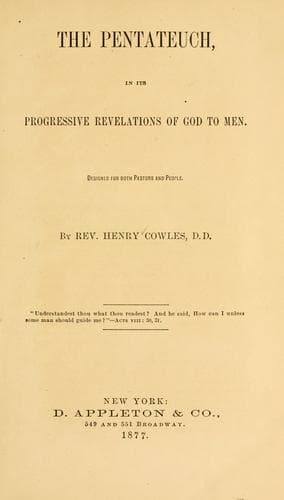
The Pentateuch, in Its Progressive Revelations of God to MenCowles, Henry
Religion
The Pentateuch, in Its Progressive Revelations of God to Men
Cowles, Henry
Bible. Pentateuch -- Criticism, interpretation, etc.
On his way back to Canaan, and consequently approaching the residence
of Esau in the land of Seir, Jacob is fully aware that his coming must
be known to Esau, and therefore he sends messengers to him for the
purpose of conciliating his good will. These messengers soon returned
to Jacob, saying; “We came to thy brother Esau, and also he cometh
to meet thee and four hundred men with him.” In an instant Jacob
comprehends the situation and sees his danger. Those four hundred
men are led on by Esau with no peaceful purpose. The lapse of twenty
years has not sufficed to quench the fire of his wrath and to revive
fraternal affection. Still unforgiving he comes on “breathing out
threatening and slaughter,” exhibiting identically the same character
which he impressed on his posterity and which manifested itself in
the vindictiveness of the Edomites at the fall of Jerusalem before the
Chaldean power. Amos (1: 11, 12) and Obadiah (vs. 10–16) represent this
vindictiveness against the posterity of his brother Jacob as the ground
and reason of God’s overwhelming judgments on their nation and land.
“Because he did pursue his brother with the sword and did cast off all
pity, and his anger did tear perpetually, and he nursed his wrath for
ever.”――――Such was the bearing of his nation toward the sons of Jacob
in the day of Jerusalem’s fall; and with this same spirit he is coming,
at the point of his history now before us, to cut off Jacob’s powerless
family.――――With admirable self-possession and wisdom, Jacob laid his
plans promptly――first, to divide his train into two parts, placing
one at some distance in advance of the other, so that if the front
column were attacked, the rear might stand some chance of escape: and
secondly, to send forward a valuable present to Esau;――“two hundred
goats; two hundred ewes and twenty rams; thirty milch camels with their
colts; forty kine; ten bulls; twenty she-asses and ten foals” (Gen.
32: 13–15)――enough at least to arrest Esau’s attention and perhaps
to soothe his spirit toward his brother. These he sent forward with
fitting words of conciliation:――but by far the most vital measure
of relief yet remained――_prayer to the Great God of the covenant_.
Vs. 9–12 record the words of this prayer, apparently as offered to
God in the first moments after the messengers returned and apprised
him of his danger. The prudential arrangements above named followed,
occupying the morning hours of the day. When night came on Jacob was
left alone save that the Lord came down in form as a man――the angel
of the covenant――and a scene of struggling, wrestling prayer ensued
which ceased not till the dawn of the morning. As the narrative has
it; “Jacob was left alone, and there wrestled a man with him until the
break of day. And when he saw that he prevailed not against him, he
touched the hollow of his thigh; and the hollow of Jacob’s thigh was
out of joint as he wrestled with him. And he [the angel-man] said, Let
me go, for the day breaketh.
Public-domain text, read in full here on John Shaqi.
Reviews
Reviews
No reviews yet
Be the first to share your thoughts on this work.
Elsewhere in the archive
Join the Discussion
Join the discussion
Sign in to leave a comment or review.
Sign InorCreate an account