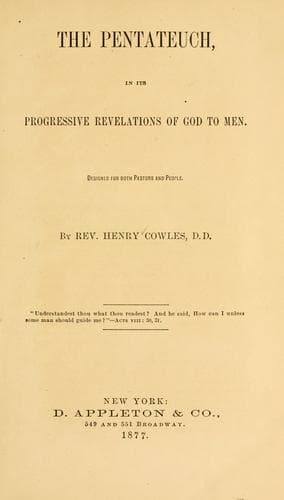
The Pentateuch, in Its Progressive Revelations of God to MenCowles, Henry
Religion
The Pentateuch, in Its Progressive Revelations of God to Men
Cowles, Henry
Bible. Pentateuch -- Criticism, interpretation, etc.
And he [Jacob] replied――I will not let
thee go except thou bless me. And he said unto him, What is thy name?
And he said, Jacob. And he said――Thy name shall no more be called Jacob,
but Israel; for as a Prince hast thou power with God and hast prevailed.
And Jacob asked him and said, Tell me, I pray thee, thy name; and he
said――Wherefore is it that thou dost ask after my name? And he blessed
him there. And Jacob called the name of the place Peniel, for I have
seen God face to face and my life is preserved.”
What we may call the costume, the purely external _forms_ of this
scene, are striking, peculiar, but thoroughly significant. In view
of the circumstances, there can not be the least doubt that, mentally,
spiritually,――_this is a scene of prayer_――nothing else, less or more.
The prayer is a struggle of soul on the part of the suppliant. He
is in trouble; he is shut up to God alone for help; and he feels that
_he can not be denied_. The scene of the wrestling must imply that God
debates this matter with the suppliant Jacob, apparently resisting,
contending,――certainly delaying, and prolonging the conflict hour after
hour of the live-long night till break of day. Seeing that he prevailed
not to silence Jacob’s supplication, _i. e._ to break his hold as
a wrestler, he touched the hollow of Jacob’s thigh, crippling the
wrestler seriously, yet leaving his arms with strength unimpaired
to hold fast his antagonist. Then as if to test Jacob’s faith and
endurance to the utmost, he said――“Let me go, for the day breaketh;”
to which Jacob replied――“I will not let thee go except thou bless me.”
Jacob as a wrestler with one thigh out of joint had become powerless
to cast his opponent; but with his arms in their full strength he could
_hold on_――and he did. The culminating point in the struggle is reached
in these remarkable words; “I will not let thee go except thou bless
me.” I can not be denied. I have thy promise: it touches this very
case――protection and succor till I return to my country; and I can
not let go my hold. I must have help now, or perish!――――The change of
name is richly significant. Jacob, _i. e._ supplanter, suggested the
deception by which he obtained from his blind father the blessing; but
with it came the rage of his brother and this present peril to himself
and to his great family. “Israel” means _a prince with God_――one who
has prevailed in the struggle of prayer and obtained the blessing
he sought. The change of name thus indicates the change in Jacob’s
relations to God and to Esau which followed his victory in this
prayer-struggle.
But what is the significance of this example? What was really the
animus of this conflict? what the reason for it; what the point in
debate, and what the great moral lessons which it teaches?
Our data for the answer to these questions must come from one or both
of two sources:
(a.) _The circumstances of the present case_;
Public-domain text, read in full here on John Shaqi.
Reviews
Reviews
No reviews yet
Be the first to share your thoughts on this work.
Elsewhere in the archive
Join the Discussion
Join the discussion
Sign in to leave a comment or review.
Sign InorCreate an account