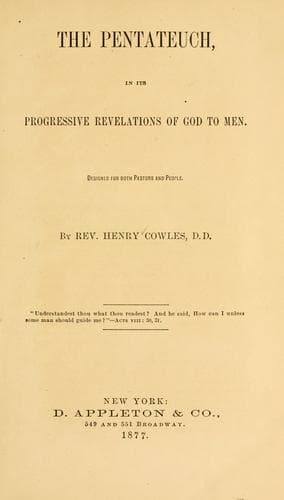
The Pentateuch, in Its Progressive Revelations of God to MenCowles, Henry
Religion
The Pentateuch, in Its Progressive Revelations of God to Men
Cowles, Henry
Bible. Pentateuch -- Criticism, interpretation, etc.
We may find some light toward the answer if we remember that every
promise of God to man must in the nature of the case _imply certain
conditions_; and the promise in this covenant equally with all other
promises. “If I regard iniquity in my heart, the Lord will not hear me.”
“Ye ask and receive not because ye ask amiss.”――――As bearing on this
very covenant let us recall the ground of the Lord’s confidence that
he should be able to fulfill his words to Abraham: “I know him that he
will command his children and his household after him, and they shall
keep the way of the Lord to do justice and judgment, _that the Lord may
bring upon Abraham that which he hath spoken of him_.”――――Now it will
be in point to consider that these scenes of danger from Esau’s rage
inevitably brought up between the Lord and Jacob the question whether
the deception practiced upon Isaac to transfer to Jacob the blessing
which legitimately fell to Esau could be passed over by the Lord
without rebuke. Was it proper that the Lord should endorse it with no
rebuke whatever? If he were ever to bear his protest against it, the
present was the time.――――Yet further, the fact had but recently come
to Jacob’s knowledge that his favorite Rachel had stolen her father’s
gods and taken them with her as she left the family home. Had Jacob
been faithful to the God of his fathers in teaching and impressing
the worship of the one true God and in protesting solemnly against
idol-worship? And had he been firm and outspoken against such theft and
deception as that of his beloved Rachel? Must not things of this sort
be inquired into and definitely settled before the Lord could interpose
with such manifest deliverance as would virtually endorse Jacob as
right before God?――――It ought not to escape our notice that while
the narrative in the preceding chapter (31) recites the misconduct of
Rachel and shows that Jacob then for the first time became aware of the
extent of her idolatry, theft, and deception, so a subsequent narrative
(35: 1–4) apprises us in a very significant way that both the Lord and
Jacob remembered this wonderful night of struggle, and that some of
the matters then in issue were set right. “God said to Jacob――Arise,
go up to Bethel [that place of so many hallowed associations] and dwell
there and make there an altar unto God who appeared to thee when thou
fleddest from the face of Esau thy brother. Then Jacob said to his
household and to all that were with him, _Put away the strange gods
that are among you_, and be clean, and change your garments, and let
us arise and go up to Bethel, and I will make there an altar unto God
_who answered me in the day of my distress_, and was with me in the way
which I went.” Yes, “he who answered me in that day of my distress,”
before whom this whole matter was reviewed and debated through that
long, fearful night――who called me to account in that dread emergency
and pointed out my sins and put my soul to most humble confession of
Public-domain text, read in full here on John Shaqi.
Reviews
Reviews
No reviews yet
Be the first to share your thoughts on this work.
Elsewhere in the archive
Join the Discussion
Join the discussion
Sign in to leave a comment or review.
Sign InorCreate an account