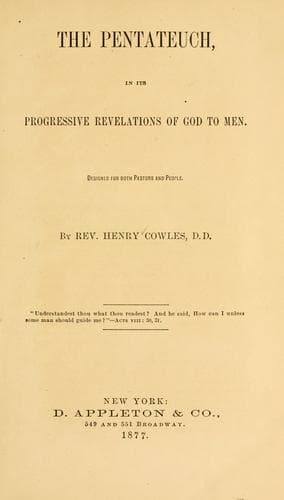
The Pentateuch, in Its Progressive Revelations of God to MenCowles, Henry
Religion
The Pentateuch, in Its Progressive Revelations of God to Men
Cowles, Henry
Bible. Pentateuch -- Criticism, interpretation, etc.
past short-comings and to most solemn vows of future service;――let
us amend our ways and our doings before the eye of this holy God who
mercifully spared us in that fearful hour. These circumstances throw
light upon this remarkable scene of prayer.
* * * * *
(b.) We may also call to mind _the principles of God’s spiritual
administration over his people in respect to answering their prayer_.
Here it is safe to say that God never delays to answer prayer without
some good reason. He could not delay from mere caprice.――――On the other
hand he may delay the blessing sought, for the purpose of holding it
before the suppliant’s mind till he shall better appreciate its worth,
and his own dependence on God alone for it, and that he may accept it
more gratefully and prize it more adequately when it comes. The reasons
for delay may often lie in this direction; but in the present case
of Jacob we must look elsewhere, since in his fearful emergency this
particular reason is scarcely supposable. His case was so urgent and
involved interests so dear and so near to his very soul that his mind
could scarce need to be sharpened to more intense desire or impressed
with a deeper sense of dependence.
Again, God often holds the suppliant in suspense for the sake of
throwing him upon self-examination. It may be simply indispensable
both for the good of the suppliant and for the honor of God that he
should be put to the deepest self-searching, to compel reflection and
consideration for the purpose of convicting him of some sin that must
needs be seen, confessed, repented of and put utterly away. We must not
overlook the great fact that when God grants signal blessings in answer
to any man’s prayer, it will be taken as a tacit indorsement on God’s
part of this man’s spiritual state. It will be considered as God’s
testimony that he is _not_ “regarding iniquity in his heart”――that
there are no iniquities palpable to the world and present to the man’s
own consciousness――indulged and not condemned and forsaken. On this
principle it often happens that God must needs compel the praying
soul to the most thorough heart-searching and to the most absolute and
complete renunciation of known sin, before he can honorably and safely
bestow signal blessings.
If now we place this obvious principle of God’s spiritual
administration alongside of the well-known facts of Jacob’s history,
we shall readily see reasons, apparently all-sufficient, for this long
delay and this remarkable struggle of prayer before the blessing was
given. The Lord was searching his servant and impressing some great
principles of practical duty upon his mind under circumstances well
adapted to insure very thorough reformation.
Public-domain text, read in full here on John Shaqi.
Reviews
Reviews
No reviews yet
Be the first to share your thoughts on this work.
Elsewhere in the archive
Join the Discussion
Join the discussion
Sign in to leave a comment or review.
Sign InorCreate an account