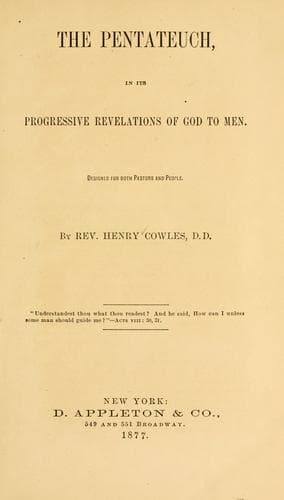
The Pentateuch, in Its Progressive Revelations of God to MenCowles, Henry
Religion
The Pentateuch, in Its Progressive Revelations of God to Men
Cowles, Henry
Bible. Pentateuch -- Criticism, interpretation, etc.
Leaving Jacob to long years of bitterest grief, we follow the fortunes
of Joseph. From this point the thread of the story takes him into Egypt
a slave. Sold to Potiphar, an officer under Pharaoh, it soon became
apparent that the Lord was with him and made every thing prosper under
his hand. He rises rapidly in the confidence of his master; is put in
charge of all his house――but here springs up a new trial. Joseph is
beautiful in person and amiable in manners. Potiphar’s wife, lewd and
shameless, tempts him with solicitations to adultery. Joseph’s bearing
in this case was worthy to be put on permanent record to pass down
through all future generations to the end of time, a perfect model of
both virtue and wisdom――the virtue that resists seductive temptation
with unwavering firmness; and the wisdom that comprehends and applies
the perfect methods of resisting temptation. Joseph did not dally with
his tempter; did not suffer the temptation to gather new force, but met
it instantly with the strongest considerations possible――“How can I do
this great wickedness and _sin against God_!” God, said he to himself,
is my best friend; I am his servant. He has stood by me through all
my trials and given me this great prosperity; his pure eye is on me;
I can not do this great wickedness against him!――――The sense of a
present God settled the question forever. There was indeed another line
of considerations――his obligations to the husband of this lewd woman.
Potiphar had trusted him most entirely; shall he abuse this trust?
Never.――――Thus Joseph’s course was at once decided. But this vile
woman persisted in her solicitations, till at length, maddened by
her failure, she plotted his death. She laid hold of his garment; he
escaped leaving it in her hands. With this for her proof she accuses
Joseph of the crime of which she alone was guilty. Joseph is thrown
into prison――because of his virtue and not because of any crime. Of
course the Lord was with him still, and again Joseph rises in the
favor and confidence of those in power; is put in charge of all matters
in the prison, and thus the Lord turned this great trial to account
to bring Joseph before Pharaoh. Long was the trial; the story of his
relations to the chief butler and the chief baker is in point chiefly
as showing how ungratefully the butler could forget his imprisoned
friend and prolong his imprisonment. But the hour of deliverance came
at last. Pharaoh’s two dreams impressed and disturbed his mind so much
that he summoned all his wise men to his help――but in vain. At this
opportune moment the chief butler remembers Joseph. He should have
spoken of him to the king two years before; but engrossed with his
own prosperity, he forgot his prison benefactor till this time. Joseph
comes to the help of the king. His first answer is beautifully modest
and fragrant with piety. “I have heard of thee, said the king, that
thou canst understand a dream to interpret it.” Joseph replies: “It
Public-domain text, read in full here on John Shaqi.
The Pentateuch, in Its Progressive Revelations of God to Men — John Shaqi
Reviews
Reviews
No reviews yet
Be the first to share your thoughts on this work.
Elsewhere in the archive
Join the Discussion
Join the discussion
Sign in to leave a comment or review.
Sign InorCreate an account