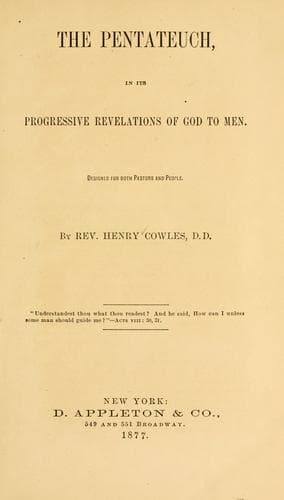
The Pentateuch, in Its Progressive Revelations of God to MenCowles, Henry
Religion
The Pentateuch, in Its Progressive Revelations of God to Men
Cowles, Henry
Bible. Pentateuch -- Criticism, interpretation, etc.
is not in me; God shall give Pharaoh an answer of peace” (Gen. 41: 16).
The dreams are interpreted to signify seven years of overflowing plenty,
followed by seven of extreme famine throughout all the land. Joseph
suggests to the king to store up the excess of the plentiful years
against the deficiencies of the famine years. The king sees the wisdom
of this suggestion and at once appoints Joseph to this responsibility;
in fact, sets him over all Egypt save only in the honors of the throne.
At this point the historic thread brings Jacob and his sons in Canaan
to view again. We are not told whether they had the seven years of
exuberant plenty there, but the years of famine were there in terrible
power. They were soon breadless. The father hears that there is corn
in Egypt; so he sends ten of his sons――all that are with him save
Benjamin――to get corn. It was to be brought on the backs of their asses,
and therefore it was wise to send them all together.
The scenes that follow are told with masterly simplicity. Joseph knows
them; they do not recognize him: What policy shall he pursue? Why, we
may perhaps ask, why does he not make himself known to them at once?
Why does he treat them so roughly; accuse them of being spies; throw
them all into prison for three days; propose to keep them all confined
save one and send him back after Benjamin; but finally compromises the
matter by taking Simeon as a hostage, binding him before their eyes,
and then consenting that the rest may go home and bring Benjamin down
as the condition of Simeon’s release? Why does he put their money into
the mouth of each man’s sack of corn? Why this long delay, and these
searching, harassing preliminaries?
It was not that Joseph was hard-hearted and rather enjoyed using his
power and taking some revenge――nothing of this sort. It is indeed said
in the first stage of this interview――“Joseph remembered the dreams
which he dreamed of them” (Gen. 42: 9), and thereupon said, “Ye are
spies; to see the nakedness of the land are ye come.” But this only
shows that his policy was settled upon the spur of the moment. He saw
what he needed to accomplish and laid his plans accordingly. The whole
narrative shows that, so far from being void of fraternal feeling and
hard-hearted, in fact it tasked his firmness of character to the utmost
to suppress his emotions sufficiently to carry out his purpose. His
main purpose was to bring them to thorough repentance. For this end he
must needs throw their thought back upon their great sin and bring the
heavy pressure of present calamity upon them with all its suggestive
power to show them that God was taking them in hand for that wickedness.
He also wished to see how they felt toward their father and toward
Benjamin. Their feeling toward both the father and his youngest son
would be an index of their penitence for their great sin toward himself.
Public-domain text, read in full here on John Shaqi.
Reviews
Reviews
No reviews yet
Be the first to share your thoughts on this work.
Elsewhere in the archive
Join the Discussion
Join the discussion
Sign in to leave a comment or review.
Sign InorCreate an account