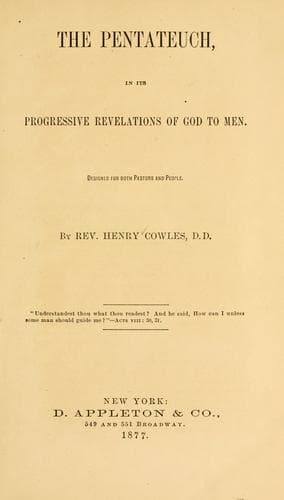
The Pentateuch, in Its Progressive Revelations of God to MenCowles, Henry
Religion
The Pentateuch, in Its Progressive Revelations of God to Men
Cowles, Henry
Bible. Pentateuch -- Criticism, interpretation, etc.
We have seen how Joseph directed the thought of his brethren to these
ways and designs of God. “Be not angry with yourselves that ye sold
me hither; for God did send me before you to preserve life.” “So now
it was not ye that sent me hither, but God” (Gen. 45: 5, 7, 8). And
again seventeen years later, after Jacob’s death, his brethren being
apprehensive lest Joseph might then relapse into revenge, he said
to them; “Fear not, for am I in the place of God? But as for you, ye
thought evil against me; but God meant it for good, to bring to pass
as it is this day, to save much people alive” (Gen. 50: 19, 20). We
should quite under-estimate Joseph’s knowledge of human nature and his
sense of moral distinctions if we were to press his words to mean that
God’s agencies in those crimes superseded theirs; lifted off their
responsibilities and left them essentially faultless.――――The reason
why Joseph’s remarks took this turn seems to have been this. He saw
that conviction for sin had done its vital work in their souls; that
they were apparently penitent and leaning toward the most severe
self-condemnation――at a stage where it was both safe and kind to turn
their attention to God’s hand as evolving good from their sin. In so
far as we can have confidence in Joseph’s judgment as to their moral
state, his words afford proof that his brethren were truly penitent,
and at a stage where consolation might properly be suggested as some
relief to their mental anguish.
The use which God made of the sin of Joseph’s brethren exemplifies his
consummate, far-reaching wisdom. He knew all the future. He saw the
coming famine; knew how to advance Joseph to the lordship of all Egypt,
and to put him there just in time to garner up the surplus of seven
years of overflowing abundance, and then dispense these stores of corn
for the sustenance of thousands less provident throughout all Egypt and
all adjacent countries. The resources of God’s providence, guided by
such wisdom, are simply boundless. What can he not do when he wills
to do it?――――The case is equally demonstrative of his _love_. Mark how
he bends the great powers of his infinite being to the production of
good, to multiply the means of happiness. This view of his character is
doubly, yea infinitely precious when studied in its developments in a
world, or rather a universe, _with sin in it_. If the Lord were obliged
to say――I must content myself with the co-operation of the good, the
unfallen, turning their agency to best account for the promotion of
happiness; but as to the wicked, they are beyond my reach; I can do
nothing with them; the evil they do must be endured as so much dead
loss to the universe, never to be of any service toward virtue and
happiness――the case would be, so far, one of unrelieved sadness. We may
bless the name of our God that his resources of wisdom and power and
the outgoings of his love are not thus limited. No indeed; some good
Public-domain text, read in full here on John Shaqi.
Reviews
Reviews
No reviews yet
Be the first to share your thoughts on this work.
Elsewhere in the archive
Join the Discussion
Join the discussion
Sign in to leave a comment or review.
Sign InorCreate an account