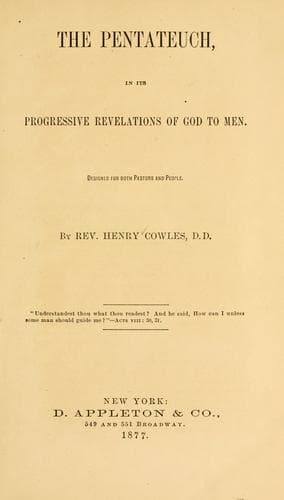
The Pentateuch, in Its Progressive Revelations of God to MenCowles, Henry
Religion
The Pentateuch, in Its Progressive Revelations of God to Men
Cowles, Henry
Bible. Pentateuch -- Criticism, interpretation, etc.
1. In answering these questions we may note that Egypt in that age
stood at the summit of the world’s civilization, a fully organized
kingdom, a great and highly cultured people. There is most ample proof
that Egypt was then eminent above any other nation in learning, wisdom,
science, and art; in jurisprudence, and in the administration of law;
in industry and in wealth; in short, in all the main appliances and
results of a high civilization. The antiquities of Ancient Egypt are
the marvel of our times. Her temples, pyramids, and obelisks; her
paintings and works of art, have come down to our age in most wonderful
preservation, living witnesses to her ancient greatness. There was
no other kingdom on the face of the earth where a man like Moses
could have been educated and trained to become the law-giver of the
Hebrew nation, or where such a system of civil law as God gave his
people by the hand of Moses could have taken its rise and could have
been understood, accepted, appreciated, and ultimately wrought into
established usage and into the national life. We shall have occasion in
its place to inquire how far the civil system given through Moses was
borrowed from the Egyptian Code, and consequently how far the scenes
of their Egyptian life prepared the way for the new national life
instituted in the wilderness.
2. The plan of transferring his people from their nomadic, pastoral
life in Canaan, to a settled residence in Egypt provided scope for all
those developments which we have been studying in the history of Jacob,
Joseph, and his brethren.
3. Yet more and greater developments of God’s mighty hand were provided
for in the deliverance of his people from their bondage in Egypt; in
his judgments on Pharaoh and his land; in the destruction of his hosts
in the Red Sea; in the wilderness life of Israel during forty years;
and at length in their location in the land of promise. All these
points will come under review in their order.
* * * * *
IV. _Some notice should be taken of ancient Egypt as affording
confirmation to the historic accuracy and truthfulness of Moses in
Genesis._
1. Moses assumes that Egypt had a king and a fully organized government.
The evidence of this from Egyptian history and antiquities is too
abundant and accessible to need citation.
2. Also that the people subsisted mainly by agriculture, not pasturage;
that their soil was exceedingly fertile and the country one of great
wealth. The facts on these points also are beyond question. The Nile
has always made Egypt rich in soil and in agricultural productions.
Its periodical inundations have sustained the fertility of that valley
for thousands of years. Alternations of years of plenty with years of
famine have been their common experience in all ages, though probably
never so extreme and protracted as in the age of Joseph.
Public-domain text, read in full here on John Shaqi.
Reviews
Reviews
No reviews yet
Be the first to share your thoughts on this work.
Elsewhere in the archive
Join the Discussion
Join the discussion
Sign in to leave a comment or review.
Sign InorCreate an account