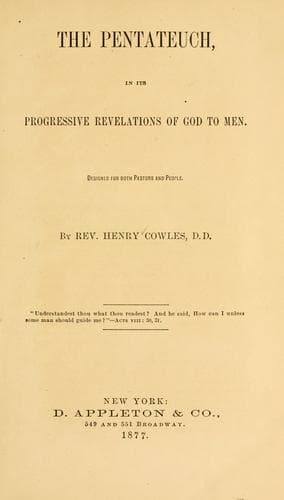
The Pentateuch, in Its Progressive Revelations of God to MenCowles, Henry
Religion
The Pentateuch, in Its Progressive Revelations of God to Men
Cowles, Henry
Bible. Pentateuch -- Criticism, interpretation, etc.
3. The history by Moses records the fact that in the early stages of
this great famine the lands passed over largely to the crown, but were
leased to the farmers for a certain portion (one-fifth) of the crops
(Gen. 47: 20–26).――――Testimony from sources other than sacred proves
these points. Herodotus was told by the priests of Egypt that the king
gave each Egyptian laborer a square piece of land of equal extent and
collected from each a yearly rent. Diodorus states that all the land of
Egypt belonged either to the king, the priests, or the military caste.
Strabo says that the farmers and tradesmen held their lands subject
to rent. In the Egyptian sculptures as shown by Wilkinson, only kings,
priests, and the military orders are represented as land-owners. [See
“Hengstenberg and the Books of Moses,” pp. 62–70.]
4. The history by Moses makes an important exception in the case of
the priests. Being supported directly from the royal treasury, they
were not obliged to alienate their lands during the great famine
and consequently continued to hold them (Gen. 47: 22). With this all
profane testimony concurs.
5. This fact implies an organized priesthood as a favored and therefore
powerful class in Egyptian society. Egyptian history confirms this and
shows moreover that they were not merely priests, performing religious
functions, but were the learned and scientific men of the nation; had
charge of education; held in their body the art and the “wisdom” of the
nation and performed largely the administrative functions of government.
“The thirty judges (says Drumann) priests of Heliopolis, Thebes, and
Memphis, were maintained by the king, and without doubt, the sons of
the priests also, all of whom over twenty years of age were given to
the king as servants; or, more correctly, to take the oversight of
his affairs.” “The ministers of the court were in Egypt the priests,
just as the state was a Theocracy, and the king was considered as
the representative and incarnation of the Godhead.” (Hengstenberg,
p. 68).――――It was by virtue of this usage that Joseph married into
the class of the priesthood, Asenath his wife being a daughter of
Potipherah priest of On (Gen. 41: 50).――――The reader will perhaps
recall the striking analogy between the Egyptian system and the Hebrew
Theocracy, particularly in the point that the ministers of religion
were also ministers of civil law and prominent in its administration.
The judges in the civil courts were taken chiefly from the tribe of
Levi.
Public-domain text, read in full here on John Shaqi.
Reviews
Reviews
No reviews yet
Be the first to share your thoughts on this work.
Elsewhere in the archive
Join the Discussion
Join the discussion
Sign in to leave a comment or review.
Sign InorCreate an account