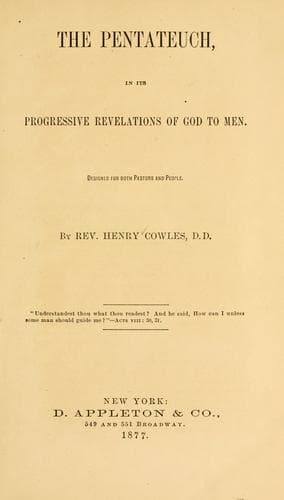
The Pentateuch, in Its Progressive Revelations of God to MenCowles, Henry
Religion
The Pentateuch, in Its Progressive Revelations of God to Men
Cowles, Henry
Bible. Pentateuch -- Criticism, interpretation, etc.
Moreover, it is natural and highly probable that Jacob whose twelve
sons were to found the twelve tribes of Israel and who knew that the
Messiah was to come in the line of _some one_ of his sons, should
indicate which. Noah had designated Shem: God had designated Abraham,
Isaac, and Jacob; now the choice is naturally made out of these twelve.
That the long promised Seed was in Jacob’s thought is forcibly and
beautifully suggested in the midst of these dying benedictions by
the words――“I have waited for thy salvation, O Lord” (49: 18). In the
sustaining hope of a coming Savior he had waited and trusted through
many long years; for these words express the precious experiences of
a life. As Jesus himself testified of Abraham, “He rejoiced to see my
day,” hailing it joyously from afar, so Jacob witnesses of himself,
“I have waited for thy salvation, O Lord.”
(b.) Those who give “Shiloh” here the geographical sense argue that
in every other case of its use in scripture, it refers to the town of
that name. This name for a town appears first in Josh. 18: 1, 8, 10,
and often subsequently in Judges, 1 Sam., etc. But there is no evidence
that in Jacob’s day it had come into use in geography. This usage, so
far as appears, was long subsequent. Nothing forbids, therefore, that
Jacob should use it simply for its significance――the Peace-giving One.
Again, the most marked supremacy of Judah began _after_ the nation had
reached Shiloh. It is therefore bad history and very inept prophecy
to represent Judah as holding the scepter _until_ the nation came
to Shiloh; the fact being that he had not held it in the full sense
previously to reaching Shiloh, but did hold it for many centuries
after Shiloh had lost its pre-eminence as the religious capital. I see
therefore no good ground for setting aside the Messianic interpretation
of this passage. The argument in its defense is ably and fully drawn
out by Keil in his Commentary, and yet more fully by Hengstenberg in
his Christology, vol. 1. pp. 50–63.
_The less readable portions of Genesis._
We have passed several portions of Genesis with little or no notice;
_e. g._ the genealogical tables, and some of the less important
sketches of family and tribal history; _e. g._ that of Abraham’s sons
by Keturah; of Ishmael, Esau, Laban, etc.
Of these less readable passages, let it be noted:
1. They are such as never could find place in a tale of fiction,
gotten up in some later age to interest and amuse the reader. The
fact that nobody finds interest and amusement in reading them now
proves conclusively that no writer of fiction could possibly have
concocted such chapters from his own fancy and have foisted them into
a professedly ancient history. The men who forge books of fiction to
pass them off as truthful history are careful not to put in unreadable
chapters――void of rational or even imaginative interest to the men of
after ages.
Public-domain text, read in full here on John Shaqi.
Reviews
Reviews
No reviews yet
Be the first to share your thoughts on this work.
Elsewhere in the archive
Join the Discussion
Join the discussion
Sign in to leave a comment or review.
Sign InorCreate an account