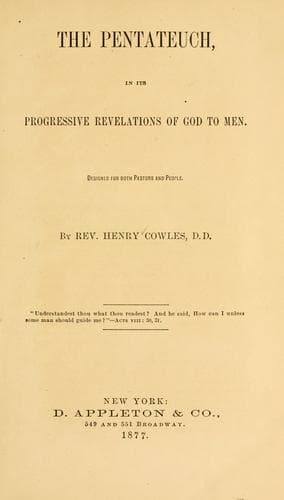
The Pentateuch, in Its Progressive Revelations of God to MenCowles, Henry
Religion
The Pentateuch, in Its Progressive Revelations of God to Men
Cowles, Henry
Bible. Pentateuch -- Criticism, interpretation, etc.
_The benediction upon Judah_ (v. 10) stands unrivaled in importance
and is not without difficulty. The main question is whether the
word “Shiloh” signifies the Messiah, in the special sense of the
Peace-giving One; or refers to the city of that name in Canaan. If it
refers to the Messiah, the sense, the application and the fulfillment
of the passage are facile and truly rich――thus: Judah shall head the
tribes and give them kings until the Great Messiah shall come: then
all the nations (Gentile and Jew) shall obey him――obedience rather than
“gathering” being the best established sense of the word. It occurs
elsewhere only in Prov. 30: 17.
No facts of Jewish history are better known than these――that Judah
led the march through the wilderness, and that from David to Christ the
scepter was in Judah――until the Messiah came, when it dropped from his
hand. “We have a law,” (said the Jewish Sanhedrim in the age of Christ)
“and by our law he ought to die”――_i. e._ for blasphemy. But under
their law, capital punishment was by stoning (Lev. 24: 15, 16, and
Mat. 26: 65, 66, and Jno. 19: 7). Having lost the power of life and
death over criminals, they were compelled to take the case to the Roman
authorities. _Their_ mode of capital punishment was crucifixion. Thus
the “cross” stands through all the ages to prove that the scepter had
departed from Judah and that the Messiah had come.――――But he came not
only to die but to reign, and the nations of the wide earth are to bow
to his scepter.――――Such is the construction of this passage, provided
the term “Shiloh” refers to the Messiah.
That it does refer to him may be argued on two grounds:
(a.) This construction is facile, natural, and supported by analogous
prophecies;
(b.) The other which makes Shiloh the name of a town in Canaan, labors
under serious, not to say insurmountable difficulties.
(a.) “Shiloh” is derived readily from the verb Shalah,[26] kindred
with Shalam, both words being in frequent use in the sense of being
at peace and in rest; expressing good wishes for peace――_i. e._ for
all prosperity――the noun from which might naturally mean the author of
peace, as we see in Mic. 5: 4. Furthermore, this distinctive feature of
the Messiah’s character and mission is the theme of Ps. 72 and of many
passages in Isaiah, _e. g._ 9: 6, 7, and 11: 1–10, and 60: 18–22. These
prophecies naturally follow the lead of this and therefore sustain the
construction here given it.
Public-domain text, read in full here on John Shaqi.
Reviews
Reviews
No reviews yet
Be the first to share your thoughts on this work.
Elsewhere in the archive
Join the Discussion
Join the discussion
Sign in to leave a comment or review.
Sign InorCreate an account