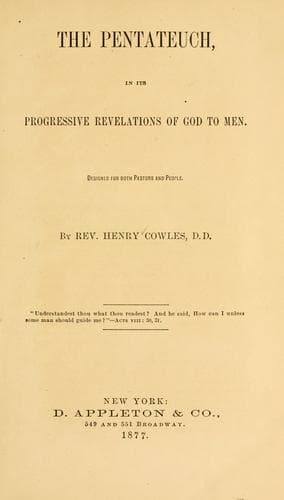
The Pentateuch, in Its Progressive Revelations of God to MenCowles, Henry
Religion
The Pentateuch, in Its Progressive Revelations of God to Men
Cowles, Henry
Bible. Pentateuch -- Criticism, interpretation, etc.
The narrative shows that this oppression consisted in part in the
exacting of terribly severe labors, especially in building, including
the making of brick, the preparation of mortar, the transportation of
these materials, and the erection of buildings. The ancient monuments
of Egypt confirm the statements of sacred history, showing that the
Egyptians employed national bondmen in the construction of their vast
national works; that they placed over them task-masters; that when the
workmen fell short of the required tale of brick, their masters put
them to more severe labors, and in some cases to labors of other sort.
It has been supposed by some that the ancient paintings represented
some of these laborers with the well-known physiognomy of the Hebrews.
It should be noted that this bondage differed from the slavery of
modern times in this one respect――that the bondmen were held by the
king and the nation in their national capacity and not by individuals.
The Hebrews were not held as private but as public property. The king
and the nation as such bore therefore the responsibility and guilt of
this oppression, and God let his judgments smite them for the most part
in such a way as to indicate their sin.
A second feature in this oppression was the king’s cruel edict to
murder the male infants. This was first enjoined upon the Hebrew
midwives. Fearing God more than Egypt’s king, they evaded obedience;
whereupon the king commanded all his people to cast the male infants
into the river.――――The reason assigned for both these measures was
_public policy_, to prevent the rapid increase of Hebrew population
which the king assumed might be dangerous to his throne and people
in case of a foreign invasion. Such a policy is at once short-sighted
and wicked; short-sighted, since kind treatment would have made this
rapidly growing people their fast friends and helpers; wicked, because
it violates common morality, insulting God, and provoking his wrath
by outraging all the obligations which he imposes on men toward their
fellows. Egypt’s king and court presently found themselves arrayed
against Almighty God and saw him take up the challenge in a fearful
conflict for mastery. We shall see in the final issue that the Lord
improved this occasion to illustrate some of the noblest principles
of his government over nations and indeed over individuals as well,
showing that he abhors oppression; takes the side of the oppressed;
hurls his fiercest thunderbolts against giant oppressors in every age;
and every-where holds men to the responsibility of using their power
to befriend and not to oppress their human brethren.
Public-domain text, read in full here on John Shaqi.
Reviews
Reviews
No reviews yet
Be the first to share your thoughts on this work.
Elsewhere in the archive
Join the Discussion
Join the discussion
Sign in to leave a comment or review.
Sign InorCreate an account