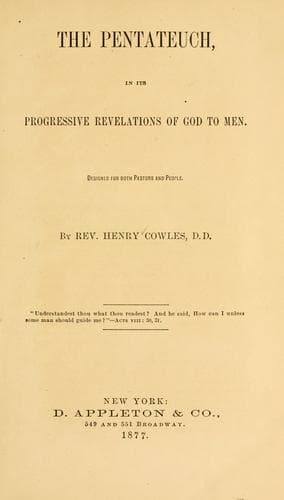
The Pentateuch, in Its Progressive Revelations of God to MenCowles, Henry
Religion
The Pentateuch, in Its Progressive Revelations of God to Men
Cowles, Henry
Bible. Pentateuch -- Criticism, interpretation, etc.
This oppression began with “a new king over Egypt who knew not Joseph.”
It is generally held that these words indicate a new dynasty――one
royal line superseded by another, perhaps a foreign power coming in
to supplant the former dynasty. The points of historic contact between
Egyptian and Hebrew chronology may at some future day be adjusted with
reasonable certainty. They are not yet. The subject is undergoing a
somewhat thorough investigation with some prospect of ultimate success.
At present I am not prepared to express positive opinions.
Two of the disputed periods in Hebrew chronology are necessarily
involved;
(a.) The period of the Judges, which as shown above some reduce to 339
years; others extend to 450;
(b.) The period of the sojourn in Egypt, made by some 215 years; by
others, 430. Some of the theories which attempt to locate this new king
of Egypt in his relation to Hebrew history place the Exodus about B. C.
1600; others B. C. 1491. Some put the commencement of the sojourn in
Egypt B. C. 2030; others B. C. 1706; yet others B. C. 1815. I have
given my reasons for adopting the longer periods. It is possible that
Egyptian authorities may yet throw a strong influence upon the decision
of these much disputed points of Hebrew chronology.
The narrative shows that the Hebrews had become numerically strong
and were rapidly growing stronger. Joseph had been dead probably a
considerable time and all the men of his generation. Being 39 years old
when his father came into Egypt and dying at the age of 110, he lived
to protect his people 71 years. Moses was 80 years old when he came
before Pharaoh, bearing the command of the Almighty――“Let my people
go.” It is probable that the terrible edict to destroy all the male
infants did not long precede the birth of Moses. The interval between
the death of Joseph and the birth of Moses will depend on the duration
of the entire sojourn in Egypt, since from this entire sojourn we must
subtract the years of Joseph’s life after the sojourn began and the
years of Moses before it closed, _i. e._ 71 + 80 = 151. This sum must
be subtracted either from 215, leaving 64; or from 430, leaving 279.
The latter I assume to be the true period. It provides abundantly for
the great increase of the Hebrew people, and accounts for the fear felt
by Egypt’s “new king.”
II. MOSES.
Public-domain text, read in full here on John Shaqi.
Reviews
Reviews
No reviews yet
Be the first to share your thoughts on this work.
Elsewhere in the archive
Join the Discussion
Join the discussion
Sign in to leave a comment or review.
Sign InorCreate an account