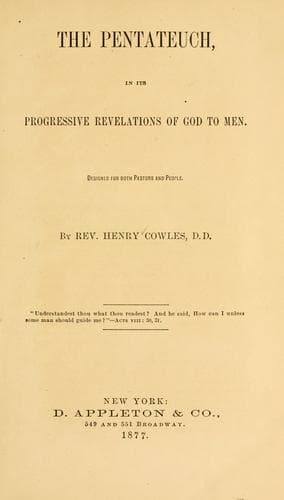
The Pentateuch, in Its Progressive Revelations of God to MenCowles, Henry
Religion
The Pentateuch, in Its Progressive Revelations of God to Men
Cowles, Henry
Bible. Pentateuch -- Criticism, interpretation, etc.
By way of preliminary explanation it should be said――that the turning
of water into blood should not be toned down to a mere discoloration
of the waters of Egypt――a reddening of such sort as customarily attends
the annual rise of the Nile, only carried in the present case somewhat
beyond the ordinary degree. For, be it noticed, the record is that the
waters were _turned to blood_; that fish could no longer live in it but
died (were the fish deceived by the mere appearance, the color?); that
the river became offensive to the smell; its waters could not be drank;
“there was blood throughout all the land of Egypt.” If this language
does not mean far more than a mere _discoloration_――something totally
different from a visual deception; in short, if it does not mean
“_turned to blood_,” then no language can be found to express it.
In the third plague, the Hebrew word for “lice”[29] were better
rendered _gnats_, yet an insect unknown to our country. Herodotus
(B. C. 400) speaks of the great trouble which they cause and of the
precautions used against them. Hartmann testifies: “All travelers speak
of these gnats as an ordinary plague of the country.”[30] “So small as
to be scarcely visible to the eye, their sting notwithstanding causes
a most painful irritation. They even creep into the eyes and nose, and
after harvest rise in great swarms from the inundated rice fields.”
(Keil.)
In the fourth plague, the word translated “swarms of flies”[31] does
not mean a mixed mass or swarm of various insects as our translators
assumed, but “a stinging, scorpion-like insect” [Fuerst], “so called
from its sucking the blood” [Gesenius]. Sonnini (in Hengstenberg’s
Moses, p. 117) says――“Men and animals are grievously tormented by them.
It is impossible to form an adequate conception of their fury when they
wish to fix themselves upon any part of the body. If they are driven
away they light again the same instant, and their pertinacity wearies
the most patient. They especially love to light in the corners of
the eyes or on the edge of the eyelids, sensitive parts to which they
are attracted by a slight moisture.” “They are much more numerous and
annoying than the gnats; and when enraged, they fasten themselves upon
the human body, especially upon the edge of the eyelids and become a
dreadful plague” [Keil].――――Obviously the American house-fly gives us
no adequate idea of this fourth plague on Egypt.
Of the sixth plague, “boils with blains,” it need only be said that
they were inflamed ulcers breaking forth into pustules, intensely
painful. The word for “boils” is the same which describes the plague
brought by Satan upon Job.
The seventh plague, _hail with lightning_, was not unknown in Egypt,
yet was by no means common, and was specially rare in Upper Egypt――more
frequent in Lower.――――The other plagues will be readily understood.
* * * * *
Public-domain text, read in full here on John Shaqi.
Reviews
Reviews
No reviews yet
Be the first to share your thoughts on this work.
Elsewhere in the archive
Join the Discussion
Join the discussion
Sign in to leave a comment or review.
Sign InorCreate an account