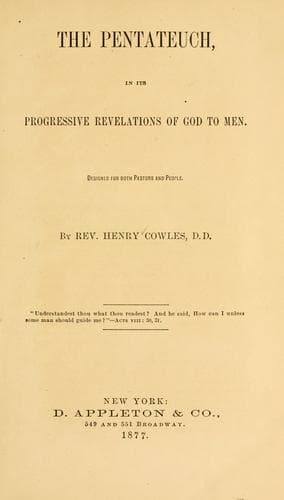
The Pentateuch, in Its Progressive Revelations of God to MenCowles, Henry
Religion
The Pentateuch, in Its Progressive Revelations of God to Men
Cowles, Henry
Bible. Pentateuch -- Criticism, interpretation, etc.
Let my people go that they may hold a feast unto me in the wilderness.”
“And Pharaoh said――Who is the Lord that I should obey his voice to
let Israel go? I know not the Lord, neither will I let Israel go.” Am
not I king over all Egypt? Do you tell me there is some higher king
than I and bid me obey his command? I know nothing of your Jehovah: I
will never submit to his authority! And as if to show how fearlessly
he could resist their summons he at once puts heavier tasks upon
the people, in proud defiance, daring the vengeance of their Great
Defender! Verily the issues hasten to their crisis!
The suffering people are entirely disheartened and evince a painful
lack of faith in the God of their fathers. When Moses rehearsed to
them the inspiring words recorded Ex. 6: 1–8, “They hearkened not
unto Moses for anguish of spirit and for cruel bondage.” Ah, how frail
is poor human nature! How weak is the faith of this long-oppressed
people! But God’s compassions are a great deep and he does not frown
severely upon them, broken down though they were in their manhood and
in their religious trust.――――Moses too seems to falter before this
stern reception from Pharaoh and this disheartening attitude of Israel
(6: 12); but the loving kindness of the Lord endures, despite of these
sad imperfections in his servants. For the glory of his own name and
not for the worthiness or virtue of his people, he has entered upon
this redeeming work and he will carry it through.
The narrative pauses a moment more (Ex. 6: 16–27) to give us the
genealogy of Levi, for the obvious purpose of showing the place of
Moses and of Aaron in this record; and then proceeds (Ex. 7 and onward)
with the impressive scenes of _the ten plagues on Pharaoh and on Egypt_.
* * * * *
A brief preliminary explanation of some of these plagues will be in
place, after which the following points will have special attention:
1. That these ten plagues on Egypt were really supernatural, miraculous.
2. That several of them were very specially adapted to Egypt.
3. The case of the magicians.
4. The divine purpose and policy in shaping the demand made upon
Pharaoh to let the people go.
5. The hardening of Pharaoh’s heart.
6. The final result as shown in the last of the ten plagues.
* * * * *
The ten plagues in their historical order stand thus:
1. Water turned to blood (Ex. 7: 14–25);
2. Frogs (8: 1–15);
3. Lice (8: 16–19);
4. Flies (8: 20–32);
5. Murrain upon cattle (9: 1–7);
6. Boils (9: 8–12);
7. Hail (9: 18–35);
8. Locusts (10: 4–20);
9. Darkness (10: 21–27);
10. Death of all first-born (11: 4–8, and 12: 12, 29–33).
References to these plagues by name may be seen in Ps. 78: 43–51, and
105: 27–38.
Public-domain text, read in full here on John Shaqi.
Reviews
Reviews
No reviews yet
Be the first to share your thoughts on this work.
Elsewhere in the archive
Join the Discussion
Join the discussion
Sign in to leave a comment or review.
Sign InorCreate an account