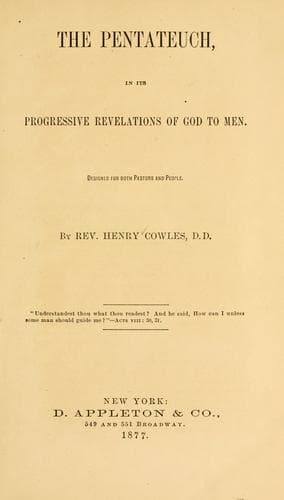
The Pentateuch, in Its Progressive Revelations of God to MenCowles, Henry
Religion
The Pentateuch, in Its Progressive Revelations of God to Men
Cowles, Henry
Bible. Pentateuch -- Criticism, interpretation, etc.
(2.) The demand made upon him that he should let the people go was
based in part at least on the religious duty of sacrificing to God in
the wilderness (Ex. 5: 1, 3)――an entirely appropriate demand――one which
Pharaoh ought to have appreciated, and one which would be more likely
to have weight with him than any other. For he was himself a worshiper
of his own gods; he knew the strength of the religious element in human
nature; he was able to recognize the universal rights of conscience
by which every man may claim to worship God according to his own
convictions of duty. If Pharaoh would not yield to this request he
would yield to none. The policy pursued was, therefore, the most
hopeful and the least likely to arouse opposition.
(3.) Even the severest honesty did not require that the Lord should put
this demand in its most revolting form in the outset. True, he might
have said from the beginning: “My people shall never return”; but this
would have at once foreclosed all hope of gaining Pharaoh’s consent.
(4.) If the question of the return of the people was thus left a very
little open――or more correctly, was not peremptorily closed, it served
the better to test the heart of Pharaoh. It left the way open to ply
him with inducements most likely to be successful; and at the same time
if he proved obstinate and self-willed, he might show it by bantering
over the conditions, higgling as tradesmen and their customers
sometimes do over the price, negotiating like diplomatists for the
most favorable terms. But this was the fault of Pharaoh, not of God.
(5.) Most frequently the demand was made in these significant words:
“Let my people go that they may serve me” (Ex. 8: 1, 20, and 9: 1, 13).
Israel is my son; his service is due to me and I claim it (Ex. 4: 22,
23). You have no right to his services; I demand therefore that you
let my son go that he may serve me.――――This is at least sufficiently
definite, and is by no means open to the slightest imputation of
lacking in the point of honesty.
5. _The hardening of Pharaoh’s heart._
In this topic, as in the one next preceding, the point of chief
interest is the moral one――that which locates the moral responsibility
for the hardening of Pharaoh’s heart――that which defines and places
truthfully the really responsible agency in the case. Was this
hardening the work of God, by his immediate hand? Was it wrought by
his power so exclusively and in such modes as to overrule and throw
out of account Pharaoh’s own responsible agency?
Or was the responsible agency that of Pharaoh only, altogether his
and his alone? Did he harden his own heart, in the exercise of his
own free will, in carrying out the purpose and desire of his own soul,
essentially as other sinners and as all sinners do?
This question is one of immensely vital moment. Let us approach it with
both care and candor.
We may reach the true answer by studying,
(1.) The history of the case;
Public-domain text, read in full here on John Shaqi.
Reviews
Reviews
No reviews yet
Be the first to share your thoughts on this work.
Elsewhere in the archive
Join the Discussion
Join the discussion
Sign in to leave a comment or review.
Sign InorCreate an account