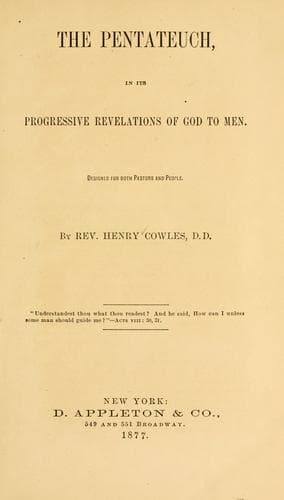
The Pentateuch, in Its Progressive Revelations of God to MenCowles, Henry
Religion
The Pentateuch, in Its Progressive Revelations of God to Men
Cowles, Henry
Bible. Pentateuch -- Criticism, interpretation, etc.
Of two facts we may be very sure. (1) They had no help from God. Their
wonders were not wrought by God’s power. We may put this denial on two
independent grounds:――――(a.) The moral purpose of their work utterly
forbids the least participation on God’s part. God never fights against
himself.――――(b.) Their power was infinitely less than divine. Compared
with God’s, it was shown to be simple weakness. “Aaron’s rod swallowed
up their rods.” Before the plague of lice they were compelled to
succumb, and (utterly against their will and against their interest)
they declare to Pharaoh――“This is the finger of God”! It utterly
distances all our skill. We can not approach it. Before the boils,
they writhed in agony. They could not even screen themselves from the
terrible infliction. Moreover it is made plain throughout the whole
transaction that they were powerless to remove even the slightest of
these plagues. If they had possessed this power Pharaoh would have put
them to this service. It is plain they shrank from even the attempt.
The whole scene was a competition between God’s power as manifested
through his servants, Moses and Aaron, and the power of Egypt’s
magicians――resulting in most overwhelming proof that the latter had not
the first element of God’s power in it.――――It follows therefore that
if the magicians had extra-human help――if they had any power beyond
human skill, _they obtained it from Satan_. We may readily suppose
they were in league with him, working according to his will. He may
have sharpened their wits by his influence, helped their arts by his
suggestions, and possibly may have given them superhuman aid in the
line of physical power. It is not given to us to know the exact limits
of his power to aid his servants. It is not essential that we should
know precisely where these limits are. We know enough to impress the
injunction――“Be sober, be vigilant, because of your adversary the
devil” (1 Pet. 5: 8). It may always be our consolation that whenever he
matches his power or his skill against the Almighty, he will come off,
as, in the case before us, utterly worsted in the fight, overwhelmed
with defeat and shame.
* * * * *
4. Some attention should be given to the divine purpose and policy
in shaping the demand made upon Pharaoh to let the people go.――――The
point of special importance here is one which has been thought to
involve the question of strict moral honesty――it being claimed that
the divine demand at first ran on this wise: “Let us go three days’
journey into the wilderness that we may sacrifice to the Lord our God”
(Ex. 3: 18)――leaving Pharaoh to assume that, this being granted, they
would return to his service.
The facts on this point are:
(1.) It was never promised or even intimated that they would return. If
Pharaoh construed the words of God and of Moses to imply this, he did
so on his own responsibility.
Public-domain text, read in full here on John Shaqi.
Reviews
Reviews
No reviews yet
Be the first to share your thoughts on this work.
Elsewhere in the archive
Join the Discussion
Join the discussion
Sign in to leave a comment or review.
Sign InorCreate an account