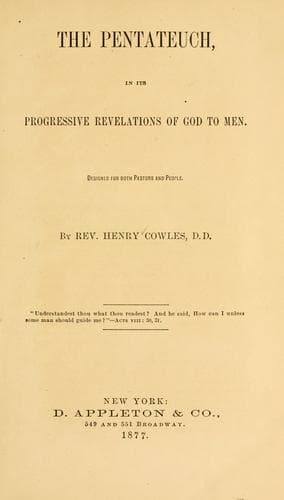
The Pentateuch, in Its Progressive Revelations of God to MenCowles, Henry
Religion
The Pentateuch, in Its Progressive Revelations of God to Men
Cowles, Henry
Bible. Pentateuch -- Criticism, interpretation, etc.
The plague of flies brings out yet another element of human nature
which not unfrequently comes into play in the hardening of men’s
hearts against God――viz. the habit of bantering――shall we say dickering,
driving a bargain and quibbling over the terms and conditions of
God’s requirements. The flies are terribly annoying: Pharaoh sees
that something must be done; in fact he concludes he must make some
concessions: so he calls for Moses and Aaron and says――“Go ye,
sacrifice to your God _in the land_.” The last words were emphatic――in
_this_ land: stay here, and you shall have time to offer your
sacrifices. I can not let you go three days journey into the wilderness
lest ye never come back.――――Moses insists on the original terms; and
then Pharaoh concedes yet a little more: “I will let you go that ye may
sacrifice to the Lord your God in the wilderness, only ye shall not go
very far away. Entreat for me”――_i. e._ entreat the Lord to take away
these flies――the same word being used here as in v. 8. Moses entreated:
the Lord removed the plague, and according to the record “Pharaoh
hardened his heart at this time also, neither would he let the people
go.” Allowing himself to make terms with God and to banter him upon the
conditions, coupled with the respite――the temporary relief found in the
removal of the plague――are manifestly the causes and modes in this case
of his hardening his own heart.
Next is the plague of murrain――a terrible loss of their cattle. In
the antecedent threatening of this plague, Moses said to Pharaoh,
“The Lord will _sever_ between the cattle of Israel and the cattle of
Egypt: there shall nothing die of all that belongs to Israel.” So it
was; for we read――“Pharaoh sent [_i. e._ to inquire] and lo! not one
of the cattle of the Israelites was dead. And the heart of Pharaoh
was hardened, and he did not let the people go” (9: 1–7). This
discrimination gave a keener edge to the plague; it cut the deeper;
but in the result it only maddened him the more. It showed most clearly
that God’s hand was in these plagues and that he was on the side of
Israel; but Pharaoh was committed to the contest and seemed to have
but the one ruling purpose――to fight it out to the bitter end.
Public-domain text, read in full here on John Shaqi.
Reviews
Reviews
No reviews yet
Be the first to share your thoughts on this work.
Elsewhere in the archive
Join the Discussion
Join the discussion
Sign in to leave a comment or review.
Sign InorCreate an account