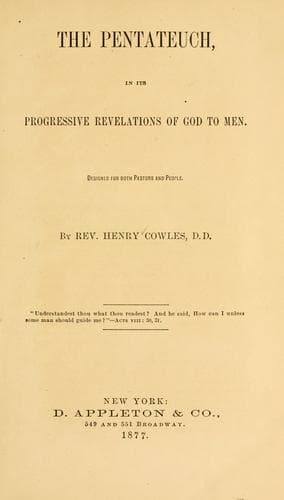
The Pentateuch, in Its Progressive Revelations of God to MenCowles, Henry
Religion
The Pentateuch, in Its Progressive Revelations of God to Men
Cowles, Henry
Bible. Pentateuch -- Criticism, interpretation, etc.
The plague of boils was a visitation of physical suffering, perhaps
somewhat adapted to make a fretful man irritable. The narrative notes
the circumstance that the magicians were completely broken down by this
plague: “They could not stand before Moses because of the boils, for
the boil was upon the magicians and upon all the Egyptians” [not upon
the Israelites]. As to Pharaoh, all human help fails him; every man
among his people seems to quail and give up the contest; yet his proud
heart is only the more maddened and the more determined! It is said,
“The Lord hardened the heart of Pharaoh and he hearkened not unto them;”
but such mad infatuation is wont to appear in depraved human souls
without any miraculous infliction of hardness from the hand of God.
There is not the least occasion to assume any other influences than
those of a proud, maddened human heart, working out its own obstinate
will against God.
The hail with attendant thunder and lightning (next in order) were
fearfully appalling. All Egyptian hearts seemed to quiver with terror
under this infliction. Pharaoh is brought (shall we say) to his knees:
he sends hastily for Moses and Aaron and says to them: “I have sinned
this time; the Lord is righteous and I and my people are wicked.” Truly
this seems hopeful. For the first time he appears penitent. “Entreat
the Lord (for it is enough) that there be no more mighty thunderings
and hail; and I will let you go and ye shall stay no longer.”――――This
seems to be a final victory over the proud heart and the long time
inflexible will of Pharaoh. He confesses sin; he begs again for prayer;
he promises to yield to God’s entire demand and let the people go.
Consequently the plague was removed. “And when Pharaoh saw that the
rain and the hail and the thunder were ceased, he sinned yet more and
hardened his heart, he and his servants.”――――Alas for man’s perverse
and false nature――his proud heart and his lying lips! How readily he
relapses back into his old and much-loved sin and becomes more hardened
than ever! The judgments of God extort confessions and tears and
prayers; but God’s mercies let off this pressure and leave the guilty
soul to fly back to its old sins again. So it was with Pharaoh. God’s
mercies, abused, worked out his ruin. But it were simply monstrous
to say that this showing of mercy is on God’s part a moral wrong and
that it throws over upon him the moral responsibility of hardening the
sinner’s heart. Yet it was precisely in this way――perhaps more really
and potently than in any other――that God hardened the heart of Pharaoh.
Public-domain text, read in full here on John Shaqi.
Reviews
Reviews
No reviews yet
Be the first to share your thoughts on this work.
Elsewhere in the archive
Join the Discussion
Join the discussion
Sign in to leave a comment or review.
Sign InorCreate an account