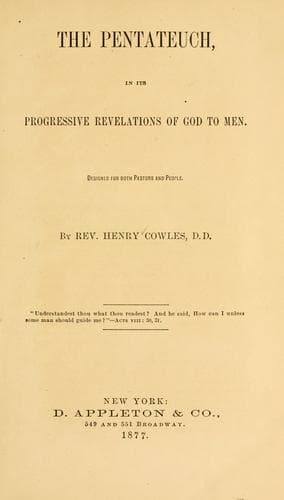
The Pentateuch, in Its Progressive Revelations of God to MenCowles, Henry
Religion
The Pentateuch, in Its Progressive Revelations of God to Men
Cowles, Henry
Bible. Pentateuch -- Criticism, interpretation, etc.
The original institution of the Passover is rehearsed quite fully
in Ex. 12 and 13; is referred to again briefly Ex. 23: 15, and 34:
18–20――this last giving emphasis to the consecration of the first-born.
A brief notice of it appears Lev. 23: 5–8; the accompanying ritual
services and offerings may be seen in Num. 28: 16–25; and a brief
resume of the institution as given in Exodus 12 and 13 stands in Deut.
16: 1–8.
* * * * *
The Paschal Lamb with its sprinkled blood became a pertinent and
impressive illustration of the central idea of the atonement by the
blood of Christ, the elements common to both being――the shedding of
blood――the blood of an innocent one――and especially the passing over
the sprinkled souls by the destroying angel, while the unsprinkled
were smitten by God’s angel of death.――――It is under the force of
these and similar analogies that Paul speaks of Christ as being “our
Passover”――[rather our Paschal Lamb], and as “sacrificed for us” (1 Cor.
5: 6–8). Pushing the analogies of the Passover feast one step further,
he thinks of the exclusion of all leaven; then of leaven as naturally
diffusive, and so as representing the pernicious influence of bad men
in the Christian church; and therefore exhorts the Corinthian church
to cast out the man guilty of incest lest his influence work like
leaven.――――These remoter analogies were forcible to persons familiar
with the feast and its usages; yet we can not say they were properly
involved in the typical significance of the Passover. The easy and
natural manner in which Paul speaks of Christ as our Paschal Lamb shows
that so far the resemblance was a well recognized fact, wrought into
the current views of inspired men, not to say, of the church of that
age. Without the shedding of blood there is no remission; with it
and by means of it remission comes to the guilty, accepting it with
penitence and with faith.
_The long route to Canaan._
Public-domain text, read in full here on John Shaqi.
Reviews
Reviews
No reviews yet
Be the first to share your thoughts on this work.
Elsewhere in the archive
Join the Discussion
Join the discussion
Sign in to leave a comment or review.
Sign InorCreate an account