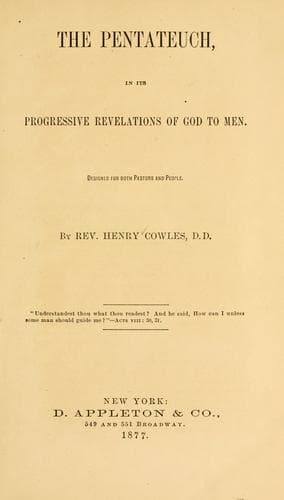
The Pentateuch, in Its Progressive Revelations of God to MenCowles, Henry
Religion
The Pentateuch, in Its Progressive Revelations of God to Men
Cowles, Henry
Bible. Pentateuch -- Criticism, interpretation, etc.
In the original institution it was specially enjoined that the history
and purpose of this great festival should _be made known to their
children_. “And thou shalt _show thy son_ in that day, saying, This
is done because of that which the Lord did unto me when I came forth
out of Egypt” (Ex. 13: 7). “And it shall be when thy son asketh thee
in time to come, saying, What is this? that thou shalt say unto him,
By strength of hand the Lord brought us out from Egypt, from the house
of bondage,” etc. (Ex. 13: 14, 15.) How naturally would this wonderful
story thrill the young hearts around the paschal board! How swiftly
would the hours fly away while fathers rehearsed to sons the great
national traditions, or read from the book of the law the narrative,
and sung again and again the song of triumph over Pharaoh fallen with
which this story closes! Jewish history has it that in ancient times
it became the custom, after the paschal table was fully spread and the
family had taken their places about it, for the servant suddenly to
remove the prepared food away. Then when the hungry children opened
their eyes wide and eager lips cried out――What does this mean? the head
of the household rehearsed slowly and solemnly the meaning and purpose
of the feast, with the history of its original institution; then when
the curiosity of the little ones had been both aroused and enlightened,
the provisions were replaced and partaken with a freshened sense of the
grand significance of the Passover.
Closely associated with this festival and fraught with solemn
significance as a memorial institution was the _consecration to God of
all first-born males_, both the first-born of man and the first-born
of beast (Ex. 13: 11–16). Of the lower animals the first-born males,
if without blemish and if suitable for sacrifice, were to be offered
in sacrifice to the Lord. If not suitable (_e. g._ the ass), it must
be redeemed with a lamb――in which case the lamb became the sacrifice,
and the ass might be used at the pleasure of its owner.
In the family, the first-born son was consecrated to God. In carrying
out this principle, a substitution was made by which the entire tribe
of Levi were put in the place of all the first-born males of Israel and
held to be specially consecrated to God. The language (Num. 8: 14–18)
is――“Thou shalt separate the Levites from among the children of Israel,
and the Levites shall be mine. They are wholly given unto me from
among the children of Israel, instead of such as open every womb, even
instead of the first-born of all the children of Israel, have I taken
them unto me. For all the first-born of Israel are mine both man and
beast: on the day that I smote every first-born in the land of Egypt,
I sanctified them for myself. And I have taken the Levites _for_ [in
the place of] all the first-born of the children of Israel.”――――The law
prescribed the rites by which the Levites were set apart (Num. 8: 5–15).
Public-domain text, read in full here on John Shaqi.
Reviews
Reviews
No reviews yet
Be the first to share your thoughts on this work.
Elsewhere in the archive
Join the Discussion
Join the discussion
Sign in to leave a comment or review.
Sign InorCreate an account