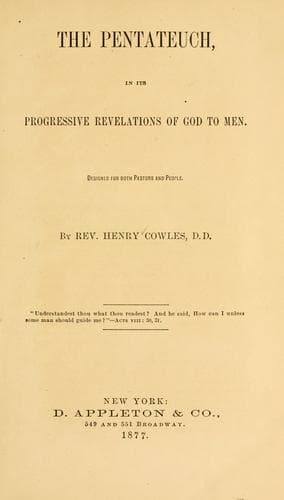
The Pentateuch, in Its Progressive Revelations of God to MenCowles, Henry
Religion
The Pentateuch, in Its Progressive Revelations of God to Men
Cowles, Henry
Bible. Pentateuch -- Criticism, interpretation, etc.
The night of the fourteenth day of the first month was one to be
long and gratefully remembered. Little sleep was there in the homes
of Israel or in the dwellings of Egypt on that eventful night. The
feast of the Paschal Lamb beginning with the early evening; the dread
visitation upon Egypt of the angel of death at midnight; the hasty
preparation for their journey throughout all the families of the
children of Israel; the gathering and mustering of their hosts for the
march of the next day:――such was the work of that memorable night. The
stages of their march are definitely chronicled; one day from Rameses
to Succoth (Ex. 12: 37); another day from Succoth to Etham, “in the
edge of the wilderness” (Ex. 13: 20); another from Etham to Pi-hahiroth
between Migdol and the Sea over against Baal-zephon (Ex. 14: 2). The
same stages appear in the official record (Num. 33: 3–8) in which it
is added that “Israel went out with a high hand in the sight of all
the Egyptians, for the Egyptians buried all their first-born whom the
Lord had smitten among them; upon the gods also, the Lord executed
judgment”[33]――so that the shock of such and so much death and their
funeral services for the dead diverted their attention from Israel and
detained them from the pursuit for a season, giving the slow moving
hosts of Israel time to reach the Red Sea before Pharaoh’s swift
chariots could overtake them.
_The guiding Pillar of cloud and fire._
At this stage commenced that striking but most precious manifestation
of God’s guiding presence, of which the first record is――“And the Lord
went before them in a pillar of a cloud to lead them the way; and by
night in a pillar of fire to give them light; to go by day and night.
He took not away the pillar of the cloud by day, nor the pillar of
fire by night, from before the people” (Ex. 13: 21, 22). If the order
of the narration corresponds in time to the order of the events, this
manifestation of the pillar commenced on the second day of their march
as they moved from Succoth to Etham “in the edge of the wilderness.”
All through those otherwise dreary days of their marching and halting
for forty years in the wilderness, this pillar was before them,
appearing as a pillar of cloud by day but of fire by night――the symbol
of Jehovah’s presence in all their way, leading their path as they
journeyed; marking their place of rest where they were to halt and
pitch their tents.――――Subsequent allusions to this pillar of cloud or
of fire are somewhat numerous, _e. g._ Ex. 29: 43――showing that _in_
this pillar God met his people and sanctified the tabernacle with his
glory: Ex. 40: 34–38, setting forth that when the tabernacle was in
readiness, the cloud covered it and the glory of the Lord filled the
most holy place, making that henceforth his special locality. Yet
the pillar of cloud was lifted above the tabernacle as the signal
for striking tents and moving forward. Its service as the signal
Public-domain text, read in full here on John Shaqi.
Reviews
Reviews
No reviews yet
Be the first to share your thoughts on this work.
Elsewhere in the archive
Join the Discussion
Join the discussion
Sign in to leave a comment or review.
Sign InorCreate an account