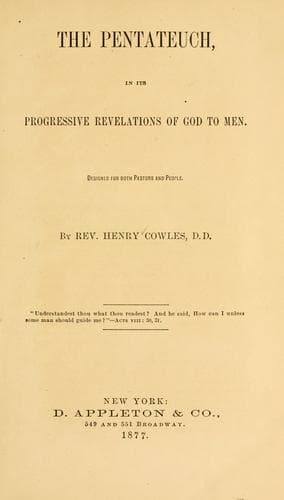
The Pentateuch, in Its Progressive Revelations of God to MenCowles, Henry
Religion
The Pentateuch, in Its Progressive Revelations of God to Men
Cowles, Henry
Bible. Pentateuch -- Criticism, interpretation, etc.
The night of doom to Pharaoh was the night of redemption to
Israel. With the morning light they “saw the Egyptians dead upon
the sea-shore”――men in their armor of battle; horses in the proud
trappings of Egypt; broken chariots, all powerless now――are dashed
up by the waves of the turbid sea and lie strewn upon the eastern
shore――memorials at once of the danger that was and of the victory and
triumph that are, and that are to be, the joy of God’s redeemed people.
Most fitly the deep emotions of the people seek expression in song. The
oldest song known to history and one of the grandest, is here before
us. “I will sing unto the Lord, for he hath triumphed gloriously:”――Ah,
indeed, it was the Lord who wrought the victory; who went down alone
into that eventful battle and who came back the mighty conqueror! “The
horse and his rider hath he thrown into the sea.” Over and over this
central idea appears: “Pharaoh’s chariots and his host hath he cast
into the sea; his chosen chariots also are drowned in the Red Sea.”
“Thou didst blow with thy wind; the sea covered them; they sank as lead
in the mighty waters.” Let the Great God of Israel be praised for all
this! Appropriately this is the burden of the song: “The Lord is my
strength and my song, and he is become my salvation.” “Who is like unto
thee, O Lord, among the gods? Who is like to Thee, glorious in holiness,
fearful in praises, doing wonders”?
Let us hope that the hearts of the saved people were deeply moved in
the spirit of this sublime song; that they saw God as never before, and
gave him the homage of their hearts, grateful, trustful, and adoring!
It may be noticed that Moses leads the thought of the people forward to
the remote results of this redemption: “The nations shall hear and be
afraid; sorrow shall take hold on the inhabitants of Palestine; all the
inhabitants of Canaan shall melt away; fear and dread shall fall upon
them ... till thy people pass over and thou hast planted them in their
promised inheritance.”
The moral results of this scene, we may hope, were really wholesome
and effective upon the multitude. It amazes us to find that so soon
afterward there were some among them who murmured for water, rebelled
against Moses, made and worshiped a calf of gold: but the young, less
depraved by their Egyptian life and perhaps more impressible by such
manifestations of God, seem to have drank in the solemn lessons of
these grand events.
Public-domain text, read in full here on John Shaqi.
Reviews
Reviews
No reviews yet
Be the first to share your thoughts on this work.
Elsewhere in the archive
Join the Discussion
Join the discussion
Sign in to leave a comment or review.
Sign InorCreate an account