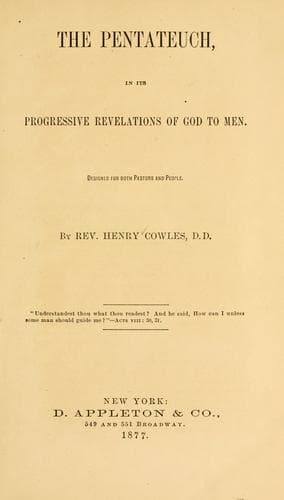
The Pentateuch, in Its Progressive Revelations of God to MenCowles, Henry
Religion
The Pentateuch, in Its Progressive Revelations of God to Men
Cowles, Henry
Bible. Pentateuch -- Criticism, interpretation, etc.
_The locality of the Red Sea crossing_ has been not a little
controverted――until the researches of modern times. Since Dr.
Robinson’s personal examination of that region, including the site of
Goshen, the route of their three days’ travel till they reached the sea,
the width of the sea at the various points between which the selection
must be made, there has been a general if not universal concurrence
in the conclusions to which he came. The location a little below Suez
where the sea was supposably not far from one mile in width; where a
strong easterly wind would drive out the waters from the channel――seems
to fulfill all the historical conditions of the problem. See his
Researches in Egypt and Palestine, Vol. I. pp. 74–86.
CHAPTER XIV.
THE HISTORIC CONNECTIONS OF MOSES WITH PHARAOH AND EGYPT.
THE thread of our history having now reached a point where we leave
Egypt and have seen the last of that one particular Pharaoh, it is in
place to take a final review of the questions――Who was this Pharaoh?
Can he be identified in the annals of Egyptian antiquities? Have any
points of chronological contact between the records of Egypt and the
records of Moses been fixed reliably so that the one system can be laid
alongside of the other and positive correspondence be made out?
Comparing the Hebrew records with Egyptian monuments and history, the
following points of coincidence may be regarded as established.
1. That (as already observed) the kingdom of Egypt was thoroughly
organized, was powerful, and had, apparently, the ripeness of age,
in the times of Joseph and of Moses. In all these respects it was
far in advance of the adjacent populations of Northern Africa and of
South-western Asia.
2. That the state of the arts, the attainments of the learned in
science, the usages of the people, the reign of law and of social
order, indicated a state of civilization much in advance of any thing
else known in that age.
3. That all the minute references in sacred history to the common
life of the people, to their occupations, to their skill in the arts,
to the productions of the country, to their political relations with
outside powers, are abundantly verified in the numerous monuments and
authorities which testify what the Egypt of that age really was. The
reference to many of these points in the history of the ten plagues
admits of most ample verification from the ancient Egyptian authorities.
4. Particularly we find in Egyptian history the means of explaining how
a new king might arise who “knew not Joseph” (change of dynasty being
a chronic infirmity); and how the monarch of an empire so magnificant,
wielding a sway so despotic, might be tempted to defy Jehovah and
proudly scorn to obey his command to “let the people go.”
Public-domain text, read in full here on John Shaqi.
Reviews
Reviews
No reviews yet
Be the first to share your thoughts on this work.
Elsewhere in the archive
Join the Discussion
Join the discussion
Sign in to leave a comment or review.
Sign InorCreate an account