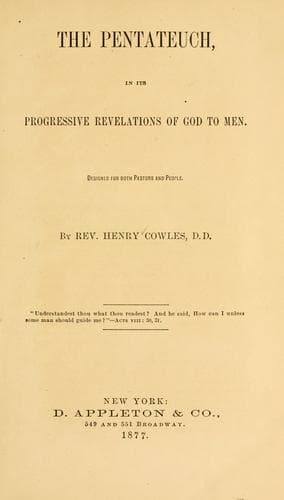
The Pentateuch, in Its Progressive Revelations of God to MenCowles, Henry
Religion
The Pentateuch, in Its Progressive Revelations of God to Men
Cowles, Henry
Bible. Pentateuch -- Criticism, interpretation, etc.
5. Yet again as to the sort of labor exacted unmercifully of the Hebrew
people the evidence from Egyptian antiquities is fully corroborative.
“They built for Pharaoh treasure cities, Pithom and Rameses,” and were
put to the severest toil in making brick; in the erection of buildings,
including the transportation of the heaviest materials; and to “all
manner of service in the field” (Ex. 1: 11, 14).――――These treasure
cities are identified with a high degree of certainty; and proximately
some of the very kings by whom this service was exacted. Mons.
Chabas[34] thinks he has found the Hebrews under name in official
Egyptian records. He argues well that it must be in vain to look in the
public monuments [_e. g._ in their temples] for any thing disastrous
to the king or to his people――those monuments being consecrated to the
triumphs and glories of the kingdom――official bulletins for this very
purpose. This consideration rules out the ten plagues; the escape of
the Hebrews; the overthrow of the Egyptians in the Red Sea. Events
so disreputable and disastrous to Egypt need not be looked for on her
sacred monuments.――――But the records on papyrus, consisting of both
official and private correspondence, military reports, surveys of
public works, financial accounts, etc., may furnish their name. The
Hebrews were an important colony, held forcibly upon the soil of Egypt,
employed largely upon her public works. Consequently some notice of
them may be reasonably looked for in the class of documents pertaining
to the business of the realm.――――Mons. Chabas maintains very sensibly
that we should look for this people under the name “_Hebrews_;” not
“children of Israel”――this being rather a religious than an ethnic
designation; not “Israelites”――this name not having then come into use;
not Jews, this name being first used many centuries later.
Three documents have been recently discovered which speak of a
foreign race under the hieroglyphic name “Aperiu.” On principles of
comparative philology, Mons. Chabas makes this word the equivalent of
_Hebrew_.――――In the first document the scribe Kanisar reports to his
superior: “I have obeyed the command which my master gave me to provide
subsistence for the soldiers and also for the Aperiu who carry stone
for the great Bekhen of King Rameses. I have given them rations every
month according to the excellent instructions of my master.”[35]――――The
second is similar: “I have furnished rations to the soldiers and also
to the Aperiu who carry stone for the sun of [the temple of] the sun,
Rameses Meriamen, to the south of Memphis.”
Furthermore, Egyptian records show that they put their prisoners of
war to such labors; for their kings record on the temples the number
of captives they have taken to labor upon the temples of their gods.
Public-domain text, read in full here on John Shaqi.
Reviews
Reviews
No reviews yet
Be the first to share your thoughts on this work.
Elsewhere in the archive
Join the Discussion
Join the discussion
Sign in to leave a comment or review.
Sign InorCreate an account