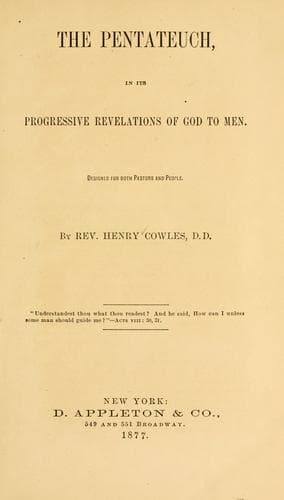
The Pentateuch, in Its Progressive Revelations of God to MenCowles, Henry
Religion
The Pentateuch, in Its Progressive Revelations of God to Men
Cowles, Henry
Bible. Pentateuch -- Criticism, interpretation, etc.
This bread took the name “manna” from the question asked by the people
when they found it upon the ground in the morning――_What_ is this?
Their Hebrew words were――Man-hu; what this? All the ancient versions
and most ancient authorities concur in deriving the name “manna” from
this original question as put in Ex. 16: 15. [Our English version has
the only correct rendering in the margin.]
The manna fell by night as the dew falls, and it would seem, fell with
and in the dew so that when the dew evaporated under the morning sun,
there remained this very fine deposit――“a small round thing, as small
as the hoar frost upon the ground.” “It was like coriander seed, white,
and the taste of it was like wafers made with honey” (Ex. 16: 13–15,
31). A subsequent description (Num. 11: 7–9) adds――“The manna was as
coriander seed and the color thereof as the color of bdellium. And
the people went about and gathered it, and ground it in mills, or beat
it in a mortar, and baked it in pans, and made cakes of it; and the
taste of it was as the taste of fresh oil. And when the dew fell upon
the camp in the night, the manna fell upon it.”――――The gathering, the
preparation of it for cooking, and the cooking itself, cost labor,
yet obviously none too much for the health and morals of the million.
The physiological facts to be noticed are that it was sufficiently
palatable for all practical purposes and had the necessary elements
for the real bread――the staff of life――for a whole nation during
forty years of wilderness life, with its alternations of marchings and
encampments; of labor and of rest.
The points which evinced the miraculous hand of God were――that it came
from no known or possible source of supply in the kingdom of nature;
that it fell in the full amount needed for the thousands of Israel;
fell on each of six mornings but not at all on the seventh, the Sabbath;
that the average amount on five of these mornings was a supply for one
day, while on the morning next preceding the Sabbath, a double quantity
fell, being a supply for two days; that the gathering for the first
five days of the week could be kept only one day, but the double supply
of the sixth day remained sweet and pure for two days; and moreover, a
quantity laid up by God’s command in the sacred ark remained unchanged
for many generations. Thus wonderfully did the Almighty impress his
hand upon every feature of this bread from heaven![37]
Public-domain text, read in full here on John Shaqi.
Reviews
Reviews
No reviews yet
Be the first to share your thoughts on this work.
Elsewhere in the archive
Join the Discussion
Join the discussion
Sign in to leave a comment or review.
Sign InorCreate an account