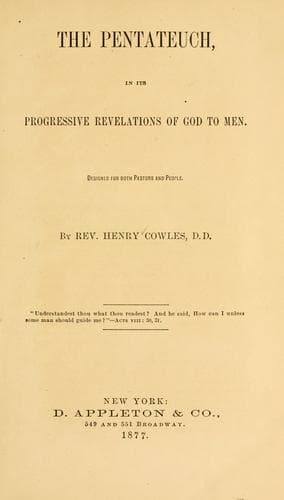
The Pentateuch, in Its Progressive Revelations of God to MenCowles, Henry
Religion
The Pentateuch, in Its Progressive Revelations of God to Men
Cowles, Henry
Bible. Pentateuch -- Criticism, interpretation, etc.
The allusions to manna in the Scriptures take note of the fact that
“God _suffered them to hunger_” before he sent them this supply (Deut.
8: 3, 16). The record (Ex. 16: 1) states that it was already the
fifteenth day of the second month since they came out of Egypt when the
whole congregation murmured for bread and seemed to themselves about
to perish of hunger in the wilderness. One month and a half must have
quite exhausted the hasty and scanty supplies which they brought from
Egypt. The marvel is how they could have subsisted upon this so long,
even though coupled with all the supplies possible in that desert.
That “God suffered them to hunger” is however only in harmony with his
usual method of dealing with his people――subjecting them to a certain
pressure of want for purposes of moral trial――the object being to test
their faith in himself; to draw out their soul in prayer for help and
in trust under darkness and in straits; and to make the blessing when
given doubly precious. What Christian has ever lived long under any
circumstances of this earthly life without some discipline under this
great law of the Christian life――“He suffered thee to hunger” and then
“fed thee with angels’ food”?
Moses (Deut. 8: 16) makes a special point of the fact that this bread
was such as neither they nor their fathers had ever known before. The
Psalmist (Ps. 78: 24, 25) takes the lofty poetic view of this great
gift of God: “He commanded the clouds from above and opened the doors
of heaven and rained down manna upon them to eat and gave them of
the corn of heaven. Man did eat angels’ food: he sent them meat to
the full.”――――Josh. 5: 12 shows that the manna ceased as abruptly as
it began, precisely when it was needed no longer. The people having
arrived in Canaan and supplies being within reach from the old corn
of the land, the manna ceased and fell no more.
An article of commerce known under the name of “manna,” produced in
the Arabian desert and in other Oriental regions, has scarcely any
points in common with the manna of Scripture save the name. It exudes
from shrubs; does not fall from the lower heavens in and with the dew;
it is obtained at the utmost only about four months of the year; is
most abundant in wet seasons――fails in the dry; is somewhat useful as
a condiment and a medicine, but can never take the place of bread; and
never has been known in such quantities as would supply bread for the
hosts of Israel.
Public-domain text, read in full here on John Shaqi.
Reviews
Reviews
No reviews yet
Be the first to share your thoughts on this work.
Elsewhere in the archive
Join the Discussion
Join the discussion
Sign in to leave a comment or review.
Sign InorCreate an account