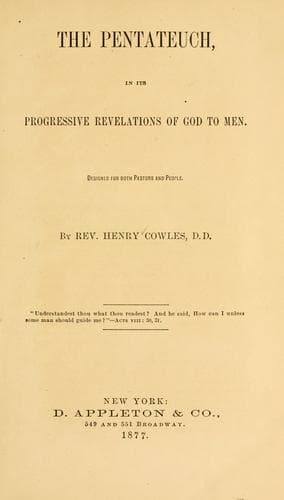
The Pentateuch, in Its Progressive Revelations of God to MenCowles, Henry
Religion
The Pentateuch, in Its Progressive Revelations of God to Men
Cowles, Henry
Bible. Pentateuch -- Criticism, interpretation, etc.
In Ex. 18, Moses narrates a visit from his father-in-law who brought
to him his wife and children, left in his care ever since the scenes
of which we read Ex. 4: 18–26. Jethro is before us here as both a good
and a wise man――_good_ in that his heart is shown to be with God and
with God’s people, “rejoicing for all the goodness which the Lord had
done to Israel whom he had delivered out of the hand of the Egyptians”
(18: 9); and _wise_ in that he saw at a glance that the burdens then
borne by Moses in the administration of justice among the people would
soon break him down; and in his admirable suggestions of a better
method which from that day became established among the Hebrew people.
For both reasons such a visit deserved a permanent record. It refreshes
us to think of that good man who had known Moses forty years as his
worthy son-in-law, yet moving only in the humble sphere of a shepherd’s
wilderness life; but now meeting him God’s recognized Leader of the
thousands of Israel and hearing from his lips the wonders God had
wrought on Egypt and on Pharaoh; the deliverance from national bondage;
the passage of the Red Sea and the entrance upon a wilderness march
underneath the cloudy pillar; subsisting on the “corn of heaven” and
on rivers of water from the rock of Rephidim; and withal having just
then achieved their first victory over the first foreign power that
dared assail them:――all this recital from the lips of such a son must
have moved the aged father’s heart with unwonted emotions. We are not
surprised that he should exclaim: “Blessed be the Lord” [your nation’s
own Jehovah] “who hath delivered you out of the hand of the Egyptians
and out of the hand of Pharaoh. Now I know that the Lord is greater
than all gods, for in the thing wherein they dealt proudly, he was
above them” (18: 10, 11).――――Then, being a priest, [“priest of Midian”
Ex. 2: 16 and 18: 1], he proceeded to offer sacrifices in the manner
which had come down traditionally from the earliest fathers. “He took
a burnt offering and sacrifices for God; and Aaron came and all the
elders of Israel to eat bread with Moses’ father-in-law before God”
(v. 12). The term “burnt offering” is usually applied to a sacrifice
which is burnt entire upon the altar. The phrase “sacrifice for God,”
refers here to a peace-offering upon portions of which the worshipers
partook in the manner of a religious feast――an act at once religious
toward God and social toward man.
Public-domain text, read in full here on John Shaqi.
Reviews
Reviews
No reviews yet
Be the first to share your thoughts on this work.
Elsewhere in the archive
Join the Discussion
Join the discussion
Sign in to leave a comment or review.
Sign InorCreate an account