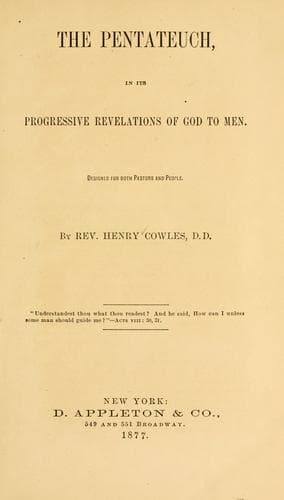
The Pentateuch, in Its Progressive Revelations of God to MenCowles, Henry
Religion
The Pentateuch, in Its Progressive Revelations of God to Men
Cowles, Henry
Bible. Pentateuch -- Criticism, interpretation, etc.
Events of most vital bearing upon the national life of the Hebrew
people are now before us. No longer one family as in Abraham and Isaac
and Jacob; no longer a mere tribe, clustering several families under
one or more patriarchs, but a group of many tribes, enlarging fast
toward the proportions of a great nation;――and what is more, a people
no longer under the emasculating incubus of bondage, but emancipated,
and free to rise and assume the duties of self-government with all its
possibilities of growth and improvement, personal and national――this
great people, were at this point summoned of God to enter into solemn
national covenant with himself. In its spirit and significance this
covenant differed in no essential point from that which God made with
Abraham more than six hundred years before. In that earlier covenant
Abraham spake for himself, and so far as it was naturally possible,
for his posterity as well; and God on his part promised to be a God not
to him only but to his seed after him; yet when this seed of Abraham
became a great people, there was special fitness in summoning them to
renew this covenant _for themselves_. Precisely this was done before
Sinai.
The Lord reminded them most appropriately of what he had so recently
done for them. “Ye have seen what I did unto the Egyptians, and how I
bare you on eagle’s wings and brought you unto myself.” It was as if
he had lifted them up from earth toward heaven and borne them forth and
out from their national bondage――as the eagle might take up her young
and bear them aloft beyond the reach of whatsoever hostile power were
tied down upon the earth’s surface. God had done this for the definite
purpose of _bringing them to himself_. “Now, therefore, (he proceeds)
if ye will obey my voice indeed and keep my covenant, then ye shall be
a peculiar treasure to me above all people, for all the earth is mine;
and ye shall be to me a kingdom of priests and a holy nation” (Ex.
19: 4–6). In this divine proposal the central word, translated here
“peculiar treasure,” appears in Ps. 135: 4 translated in the same way;
but in Deut. 7: 6 with a different translation――“A _special people_
unto himself, above all people that are upon the face of the earth.”
The sense is――a special property――a people by the choice of God and
by their own voluntary consecration, made peculiarly his own. Moses in
Deuteronomy (as above) labors to impress upon the people the thought
and purpose of God in this covenant relation: “The Lord did not set his
love upon you nor choose you because ye were more in number than any
[other] people; for ye were the fewest of all people; but because the
Lord loved you and because he would keep the oath which he had sworn
unto your fathers, hath the Lord brought you out with a mighty hand and
hath redeemed you out of the house of bondmen from the hand of Pharaoh
king of Egypt.” Of kindred significance are the other phrases used to
Public-domain text, read in full here on John Shaqi.
Reviews
Reviews
No reviews yet
Be the first to share your thoughts on this work.
Elsewhere in the archive
Join the Discussion
Join the discussion
Sign in to leave a comment or review.
Sign InorCreate an account