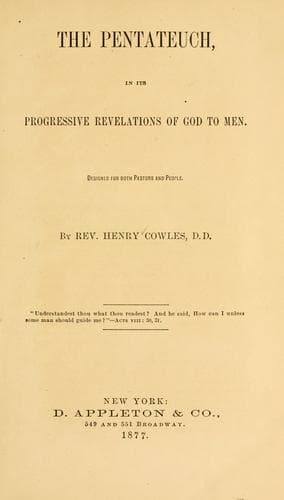
The Pentateuch, in Its Progressive Revelations of God to MenCowles, Henry
Religion
The Pentateuch, in Its Progressive Revelations of God to Men
Cowles, Henry
Bible. Pentateuch -- Criticism, interpretation, etc.
express their new proposed relation to God――“A kingdom of priests and
a holy nation.” This strong language――“a kingdom of priests”――gives
us the thought of a _whole people_――every man in all the nation,
personally consecrated to God, as if the nation were made up of priests
and of such only. God would have them understand that the holiness he
required of them was not the professional service of a chosen few, but
the free-will offering of every man’s own heart and life. The whole
people――every individual man――was summoned to come into this national
covenant. Would they come?
Moses called for the elders――who acted as the representatives of the
whole people and “laid before their faces all these words from the
Lord.” At once all the people answered together and said――“All that
the Lord hath spoken we will do.”――――Let us hope that a fair proportion,
including at least many of the representative men of the nation, were
thoroughly sincere in this profession. It would be grateful to our
feelings to believe that they all both understood and meant what they
said. But, alas! subsequent developments forbid this belief. It was
however the formal consent of the nation. As a whole people they gave
their voice to this definite proposal from the Lord their God――that he
would be their God and that they would be his people.
* * * * *
The next thing in order, is the _giving of the law_. A people who
propose to be the Lord’s and to obey his voice, should be made
acquainted with his will in the form of _law_. They must be informed
what he would have them _do_. Rules of heart and life, precepts
defining the reverent homage and worship due to God, and the acts
required or forbidden as toward their fellow-men should be made
unmistakably plain. Preparations are accordingly made for the formal
and solemn promulgation of this great moral law. It is noticeable that
in these preparations nothing seems to be omitted that might conduce
to a deep and solemn impression. The people are specially enjoined to
sanctify themselves, and two full days are set apart for this purpose.
They were commanded to “wash their clothes”――significant of the
personal purity of heart which God required.――――Then the surroundings
were of the most imposing and impressive character. The whole people
were gathered in an open plain which lay at the foot of Sinai. The most
stringent precautions forbade all curious, irreverent approach. Not a
man or beast might touch the mountain on pain of death. Definite bounds
were set for the people over which no one might pass. There before them
full in view stood the awful mount――rugged, grand, cleft with fissures,
broken with deep ravines, towering in sublime height and all enwrapped
in thick clouds out of which lightnings flashed――the whole mountain
rocking under the footsteps of the Almighty and reverberating with
his awful thunder, and the voice of trumpet exceeding loud so that all
the people in the camp trembled.
Public-domain text, read in full here on John Shaqi.
Reviews
Reviews
No reviews yet
Be the first to share your thoughts on this work.
Elsewhere in the archive
Join the Discussion
Join the discussion
Sign in to leave a comment or review.
Sign InorCreate an account