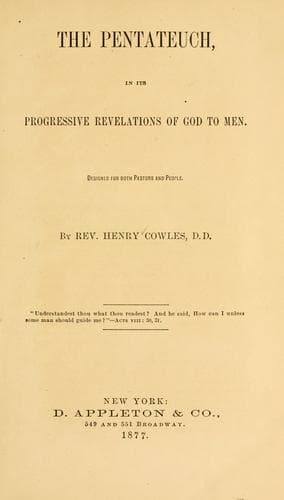
The Pentateuch, in Its Progressive Revelations of God to MenCowles, Henry
Religion
The Pentateuch, in Its Progressive Revelations of God to Men
Cowles, Henry
Bible. Pentateuch -- Criticism, interpretation, etc.
As given here the law of the Sabbath is expanded into its
legitimate details. The prohibition of labor is applied to children,
to servants, to cattle and to strangers. Then the reason for the
command, essentially as given in Eden, is reiterated; “For in six days
the Lord made heaven, earth, sea, and all creatures; but rested on
the seventh day; therefore he blessed and hallowed this Sabbath-day.”
Noticeably, the statement following “therefore,” uses the same Hebrew
verbs――“bless,” and “sanctify” [or “hallow”] which are used Gen.
2: 3.――――It seems plainly implied that God places before men his own
example of creative work during six day-periods and of rest from this
work on the seventh as a reason or motive for their observance of the
Sabbath――one day of rest after six of toil. A secondary consideration
is doubtless that by this arrangement the Sabbath would be perpetually
suggestive of man’s relation to God as his Infinite Creator and Father.
The linking of the Sabbath to God’s creative work and rest would
naturally make that work a fact ever present to human thought――blending
its influence with the sacredness and with all the employments of this
holy day. Man desists from labor. Why? Because God did. After what
labor? That of making the heavens and the earth and man. Therefore let
man remember God as his Creator and render him the homage of obedience
and the homage of adoration, gratitude and praise. Thus the historic
origin of the precept became suggestive of the thoughts, the words, and
the divine worship appropriate to this holy day.
It is scarcely in place here to discuss the Christian change from the
seventh to the first day of the week, further than to remark that a
similar suggestive influence came in as the purpose and object――_the
choice of the day suggesting the resurrection of Christ_. The original
reference to God as Creator need not be practically lost: but we
may practically gain a second group of suggestive and most vital
truths――those which cluster round the resurrection of our Lord.
Public-domain text, read in full here on John Shaqi.
Reviews
Reviews
No reviews yet
Be the first to share your thoughts on this work.
Elsewhere in the archive
Join the Discussion
Join the discussion
Sign in to leave a comment or review.
Sign InorCreate an account