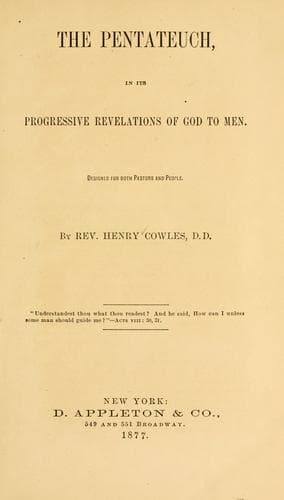
The Pentateuch, in Its Progressive Revelations of God to MenCowles, Henry
Religion
The Pentateuch, in Its Progressive Revelations of God to Men
Cowles, Henry
Bible. Pentateuch -- Criticism, interpretation, etc.
III. In the third command the exegetical question is whether it refers
primarily and properly to perjury, or to profanity, _i. e._ whether the
Hebrew word for “_in vain_”[40] is precisely falsehood, or emptiness, a
nothing, a thing of no worth. The current of critical opinion (Gesenius,
Fuerst, etc.) goes for the former, falsehood; and makes the precept in
its strict sense condemn perjury. Thou shalt not take up the name of
Jehovah to a falsehood――shalt not use it to affirm the more solemnly
what is false. Yet as what is false has no foundation in fact, and in
point of truth is nothing――is only an emptiness――it comes to pass that
this Hebrew word takes not infrequently this secondary sense; what is
_empty_, _vain_. Hence some able critics [_e. g._ Keil] construe this
precept to prohibit “all employment of the name of God for vain and
unworthy objects so as to include not only false swearing, but trivial
swearing in the ordinary intercourse of life and every use of the
name of God in the service of untruth and lying――for imprecations,
witchcraft, or conjuring.”――――The construction of Keil, being the
more broad and comprehensive, and withal being clearly within the
established usage of the original word, is to be preferred. The
doctrine of inspiration is――“Thy commandment is exceeding broad” (Ps.
119: 96).――――The _name_ of God is associated closely with the idea and
thought of God. Hence all irreverent use of this name naturally begets
irreverence of spirit toward God, and must be fearfully pernicious.
Using God’s sacred name to affirm the more solemnly a falsehood is more
than mere irreverence, and must incur his highest displeasure.
The fourth command――the law of the Sabbath――has been already treated
somewhat fully in connection with the original institution of the
Sabbath in Eden. I must dissent entirely from those critics who deny
the existence of any Sabbath law prior to Sinai. To “bless the seventh
day and sanctify it” (as said in Gen. 2: 3) has no meaning if it do
not mean that God required the day to be one of rest from labor――a day
of holy time, devoted to other than ordinary uses.――――Fully in harmony
with this construction of these words is the allusion to the Sabbath
in the history of the manna (Ex. 16: 22–30), and also the _form_ of
the precept here (Ex. 20: 8), which is not precisely――Thou shalt do
all thy work during six days, but none on the seventh;――but it is this:
“_Remember_ the Sabbath-day to keep it holy.” The implied injunction
of the words spoken in Eden was――make it a holy day. God blessed the
seventh day and made it holy: now, therefore, _remember_ that original
injunction. To remember a previous day made holy, must surely imply a
precept setting it apart as holy time.
Public-domain text, read in full here on John Shaqi.
Reviews
Reviews
No reviews yet
Be the first to share your thoughts on this work.
Elsewhere in the archive
Join the Discussion
Join the discussion
Sign in to leave a comment or review.
Sign InorCreate an account