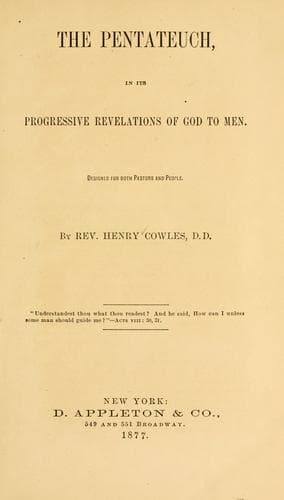
The Pentateuch, in Its Progressive Revelations of God to MenCowles, Henry
Religion
The Pentateuch, in Its Progressive Revelations of God to Men
Cowles, Henry
Bible. Pentateuch -- Criticism, interpretation, etc.
VI. The next four precepts are a series beginning with the most vital,
designed to protect the rights of person and life; of chastity; of
property; and of reputation. The precepts forbid murder, adultery,
theft, false witness, or defamation. The prohibition of murder must
be construed broadly enough to forbid personal injuries on the one
hand; and on the other all those passions――hate, malice prepense――which
naturally lead on toward violence and murder.――――The prohibition of
adultery in like manner forbids not only all illicit sexual connection,
but even unchaste desire (Matt. 5: 27, 28). So the prohibition of theft
devolves the duty of caring for our neighbor’s property so far as the
law of loving our neighbor as ourself would require. It is not enough
that we do not take his property and appropriate it to our own use.
We must protect his right to his property as he should ours. In like
manner the law forbidding the bearing of false witness against our
neighbor involves the duty of protecting and cherishing his reputation.
We may never forget that our neighbor’s good name is a treasure to him
which we not only must not steal away, but must so far as in us lies
guard and defend as if his good were worth as much as our own. The one
comprehensive principle which embraces all these points of law toward
our neighbor and determines their true interpretation is given in the
law of Moses as well as in the law of Christ――“Thou shalt love thy
neighbor as thyself” (Lev. 19: 34 and Matt. 22: 39 and 19: 19). As to
this passage from Moses it should be noted that _in terms_ it speaks
not precisely of one’s neighbor but of the _stranger_――one toward
whom you are wont to think your obligations less than toward any other
human being; for he is not a brother born of the same father――not a
relative of the same tribe――not a citizen of the same commonwealth
or nationality; but an alien, a foreigner, a stranger toward whom you
recognize no other relation than that of a fellow-being of human kind.
Of such an one the law holds――“The stranger that dwelleth with you
shall be unto you as one born among you, and _thou shalt love him as
thyself_; for ye were strangers in the land of Egypt: I am the Lord
your God”――and I enjoin upon you this all-embracing love for the lowest
of human kind.
Public-domain text, read in full here on John Shaqi.
Reviews
Reviews
No reviews yet
Be the first to share your thoughts on this work.
Elsewhere in the archive
Join the Discussion
Join the discussion
Sign in to leave a comment or review.
Sign InorCreate an account