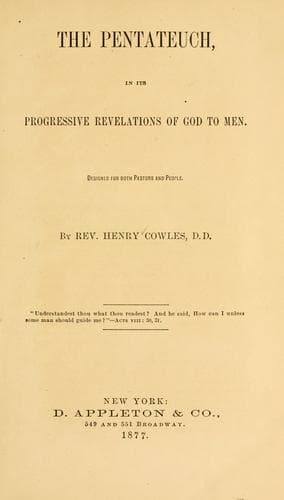
The Pentateuch, in Its Progressive Revelations of God to MenCowles, Henry
Religion
The Pentateuch, in Its Progressive Revelations of God to Men
Cowles, Henry
Bible. Pentateuch -- Criticism, interpretation, etc.
It should be carefully noted that although this group of four commands
(6–9) in each case specifies the extreme form of the sin, the law
by no means limits its prohibition to this extreme form. Killing is
the extreme of personal violence; adultery (strictly the crime of the
married) is the most aggravated form of unchastity; theft is more than
simply being reckless of your neighbor’s property; and false witness
naturally contemplates a case in court――public, formal, and of most
grave and momentous consequences;――yet in each and every one of these
prohibitions it behooves us to remember that God looks at the heart;
that the spirit is more than the letter; that the law which specifies
the extreme form of a special sin forbids with its full force all
the lower grades and all the less flagrant and revolting forms of the
same sin. We wrong ourselves most fearfully when we labor to ease our
conscience by limiting the prohibitions of God’s law to the extreme
forms of sin which may be named in the statute. It is always our
highest wisdom to deal very honestly with our own conscience as before
God in the construction and application of his law.
The tenth and last commandment is peculiar, as compared with all others
of the second table, in this point――that it specifies no external act
whatever but lays its prohibition directly _upon the heart_. “Thou
shalt not covet”――shalt not allow thyself to _desire_ in such a way as
might tempt thee to try to obtain――thy neighbor’s house, wife, servants,
cattle, or any thing that he has. This law aims to forestall temptation.
It strikes at the root of such sins as theft and adultery by forbidding
any such desire as might move you toward the sin. It may be regarded
as shielding both of the two parties; the one who might commit the
sin, and the one against whom the sin might be committed. It throws
its shield over him who might otherwise be tempted, and it also becomes
in so far a safeguard around him who holds treasures which lustful eyes
might covet.
Public-domain text, read in full here on John Shaqi.
Reviews
Reviews
No reviews yet
Be the first to share your thoughts on this work.
Elsewhere in the archive
Join the Discussion
Join the discussion
Sign in to leave a comment or review.
Sign InorCreate an account