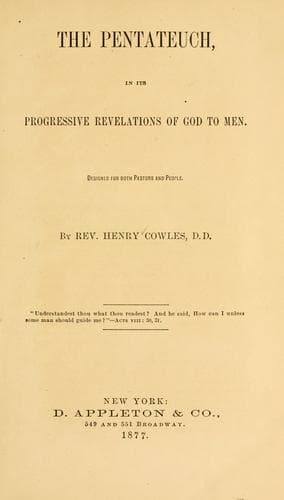
The Pentateuch, in Its Progressive Revelations of God to MenCowles, Henry
Religion
The Pentateuch, in Its Progressive Revelations of God to Men
Cowles, Henry
Bible. Pentateuch -- Criticism, interpretation, etc.
Yet again; This portion of historic revelation _abounds with
testimonies to the power of prayer_ and to its place in the relations
of God to man and of man to God. We see these revelations in the
history of the plagues on Egypt. So palpably manifest was the power
of Moses with God in prayer that even proud Pharaoh saw and recognized
it. Over and over again the king besought the prayers of the man of
God――apparently with unlimited confidence that God would grant whatever
he should ask. Though he never had seen such power in prayer before,
the force of the facts was too great to be resisted. For once he became
so far a believer in the communion of man with God, and also in the
power of God to work wonders which man’s power alone could never reach.
The war scenes with Amalek and the prayer which turned the victory
to Israel’s side will be readily recalled. As already suggested, this
specimen case, brought out so perfectly in the first national conflict
of arms, was well adapted to send down to future ages the great secret
of success against their national enemies. How happy for Israel if
it had never been forgotten! How well for the Christian world if the
lessons of that scene were faithfully transferred and applied in all
spiritual conflicts against foes within and foes without which pertain
to this ever militant state!
It is scarcely necessary to speak in fuller detail of the revelations
of God to man _through miracle_. Every page of this history teems with
miracles. Take the miracles away, and truly there would be nothing left.
The revelations of God’s will to Moses; the judgments on Egypt; the
redemption of his people from bondage there; the scenes at the Red Sea;
the bread and the water for his needy people; the pillar of cloud and
of fire; the glories of Sinai and the giving of his law in voice of
majesty:――what are all these but miracles――the Great God over-stepping
the ordinary course of nature to impress himself, the power of his arm,
the mandates of his will――upon human minds? No other such chapter on
miracles appears in the Old Testament. Nowhere else do they cluster
so grandly; not elsewhere do they so much supersede the common laws
of nature and give character to the entire course of the divine
administration. Most abundantly do they testify that the arm of the
Lord is equal to any result which his wisdom may devise. If he has
purposes to accomplish he can not lack the means or the power necessary.
The age of miracles can be brought round again if so he wills it. But
more to our purpose is the inference to the adequacy of his resources
in general, whether with or without miracle.――――Yet let us not miss
the more vital truth that this cluster of miracles aimed to witness
to God’s present hand working with Moses, endorsing his mission and
accrediting his words from the most High. God was then specially active
in “making history” (shall we say?)――_making history to put into his
Bible_.
Public-domain text, read in full here on John Shaqi.
Reviews
Reviews
No reviews yet
Be the first to share your thoughts on this work.
Elsewhere in the archive
Join the Discussion
Join the discussion
Sign in to leave a comment or review.
Sign InorCreate an account