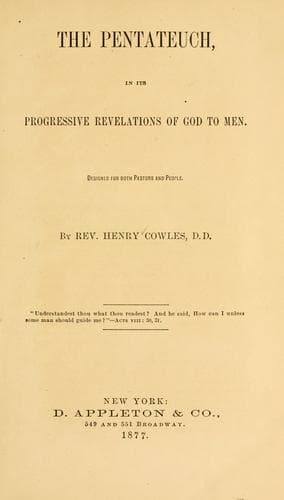
The Pentateuch, in Its Progressive Revelations of God to MenCowles, Henry
Religion
The Pentateuch, in Its Progressive Revelations of God to Men
Cowles, Henry
Bible. Pentateuch -- Criticism, interpretation, etc.
Again, we see here the _possibility of very great intimacy of communion
between God and man_. As bearing on this point the reader will review
the scene between Moses and the Lord at the burning bush; in his
mission to Pharaoh; in the special directions given him in regard to
the sending of each several plague, and usually as to its removal as
well. Did ever earthly Potentate stand on more intimate terms with his
prime minister? Or military chieftain with his subordinate officer? If
Moses was at any point reluctant, under a conscious sense of capacities
unequal to the work and of difficulties he could not surmount, did he
not bring the matter before the Lord with at least as much freedom as
the case could justify?――――Especially when we think of Moses coming
so near to Jehovah in his majesty wielding the terrific agencies of
flood and storm and fire, of darkness and lightning and the voice of
trumpet exceeding loud――Mt. Sinai rocking beneath his feet, and Moses
alone drawing near the Awful Presence and talking with God face to face
there――what shall we say of the possibilities of communion between man
and his Maker? Whatever speculations we may have as to the means and
methods by which the thought of God was borne to the mind of Moses and
the thought of Moses to the mind of God, the great fact of _communion_
of mind with mind――thought meeting thought――of command from the
superior party, received and obeyed by the inferior――is on the outer
face of the whole history and admits of no question. God can speak to
man so that man shall know the voice to be his and comprehend perfectly
its significance. Relations of obedience, confidence, and love on the
part of man toward his Maker are established, and God meets them with
appropriate manifestations of his favor.
This great fact is one of telling significance in the whole province
of Christian experience. Its significance can not terminate with the
present life but must pass on to be unfolded far more gloriously in
the revelations of the eternal world. “It doth not yet appear” [in all
points] “what we shall be”――but it does appear that God has made us
capable of exceedingly intimate relations to himself――as we shall know
more perfectly when we shall see as we are seen and know as also we are
known.
Public-domain text, read in full here on John Shaqi.
Reviews
Reviews
No reviews yet
Be the first to share your thoughts on this work.
Elsewhere in the archive
Join the Discussion
Join the discussion
Sign in to leave a comment or review.
Sign InorCreate an account