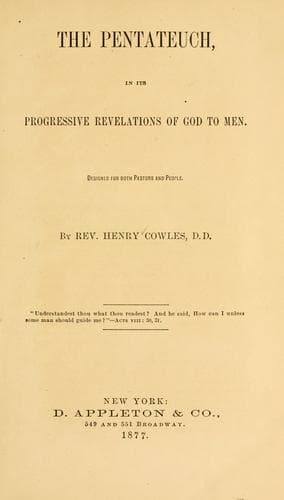
The Pentateuch, in Its Progressive Revelations of God to MenCowles, Henry
Religion
The Pentateuch, in Its Progressive Revelations of God to Men
Cowles, Henry
Bible. Pentateuch -- Criticism, interpretation, etc.
4. In all cases not otherwise provided for, the ultimate appeal was
to God. In point we have (Num. 16 and 17) a case of resistance to
the authority of Moses――incipient rebellion. God interposed with his
supreme authority. We have a case in civil law, not reached by the
statutes, viz. the entailment of real estate in a family of daughters
only. Moses brought it before the Lord for adjudication (Num. 27: 5). A
special provision respecting the marriage of daughters holding property
in land became necessary: this new law was sought from God (Num.
36: 6).――――A criminal case occurred in which the law was not explicit;
“it was not declared what should be done” with the criminal (Num. 15:
32–36). The Lord gave them the law for the case.――――In the case of
Achan (Josh. 7) the Lord interposed, not so much because there was no
law for its decision as because the sin was flagrant and the demand
for exemplary punishment was very great.――――In cases which would
appropriately require the calling of a Supreme Council, the people
sought direction from God. (See Judg. 1: 1, and 20: 18, 27, 28 and 1
Sam. 14: 37, and 23: 2, 4, 9–12, and 28: 6, and 30: 8 and 2 Sam. 2: 1).
God made provision through the prophets for a direct revelation of his
will to the people in special cases not otherwise provided for (Deut.
18: 18).
5. In later times the demand of the people for a human king seemed to
be constructive treason. It might be so understood, and therefore the
Lord reasserted his prerogative, although he yielded to their demands
(1 Sam. 8: 6–9, and 10: 17–25).
6. It scarcely need be said that God bound himself by promise to reward
the people with all national prosperity if obedient, and by threatening,
to punish them with national calamity for disobedience. These points
are expanded fully Lev. 26 and Deut. chapters 27–30.――――That God
inflicted these threatened punishments early in their nation’s history
may be seen Num. 11: 33, and 16: 1–50.
Thus it appears that in every appropriate way and in numerous vital
respects God manifested his supreme authority over his people Israel.
II. _The powers of Jehovah’s vicegerent._
Of this we have illustrations in the cases of Moses, Joshua, the Judges,
and the kings. These cases show that they were precisely the Lord’s
prime ministers, commissioned to execute his will. If a law touching
the case existed and its application was clear, they simply adjudicated
the case and put the law in force. If no statute touching the case was
extant, they sought one. If the application of the law baffled their
wisdom, they sought counsel from God. Hence the Scriptures speak of
these prime ministers as the Lord’s “servants,” to serve him in this
high capacity. (See Num. 12: 7 and Heb. 3: 2, 5 and Josh. 1: 1, 2, and
5: 13–15 and 2 Sam. 7: 8, etc.)
Public-domain text, read in full here on John Shaqi.
Reviews
Reviews
No reviews yet
Be the first to share your thoughts on this work.
Elsewhere in the archive
Join the Discussion
Join the discussion
Sign in to leave a comment or review.
Sign InorCreate an account