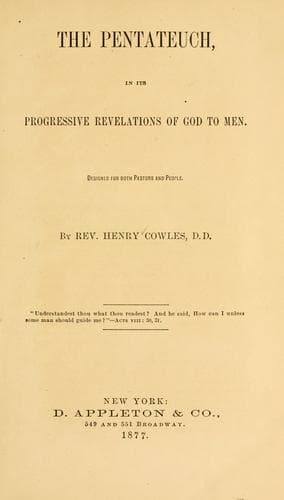
The Pentateuch, in Its Progressive Revelations of God to MenCowles, Henry
Religion
The Pentateuch, in Its Progressive Revelations of God to Men
Cowles, Henry
Bible. Pentateuch -- Criticism, interpretation, etc.
Of the officers holding under the chief executive there is no occasion
to speak in great detail. The system of subordinate judges――lower
courts――has come to view in the history of Jethro (Ex. 18). In Canaan
they held their courts in the gates of large cities, and (for certain
criminal cases) in the cities of refuge which were cities of the
Levites――from which tribe judges seem largely to have been drawn.
The “elders”――“heads of the house of their fathers”――held important
responsibilities――a fact due largely to the influence of the
patriarchal system which had come down from the earliest times, the
usages of which, therefore, had essentially the force of common law
in Israel. It was in great measure due to them that after the death of
Joshua the processes of government went on without any chief executive,
with no king, and with no Supreme Judge except as the High Priest may
have performed that function.
III. _The General Assembly or Congregation, and the Elders._
We read of great conventions, congregations, assemblies, in which
it is not definitely said that _all the people_ were there; and
also of convocations in which “all the people” were present. In some
at least of the cases of the latter sort, the elders seem to have
acted distinctly from the masses of the people, being the media of
communication (as the case may be) between the Lord or his servant
Moses of the one party and the people at large of the other. Thus
shortly before the giving of the law from Sinai when God ratified
a national covenant with the people, we read――“Moses called for the
elders of the people and laid before their faces all these words
which the Lord commanded him. And all the people answered together
and said――All that the Lord hath spoken we will do” (Ex. 19: 7, 8).
Moses spake to the people _through_ their elders. It was naturally
impossible that any one human voice could be heard by six hundred
thousand men.――――So in 1 Sam. 8: 4–10 “the _elders_ gathered together
and said to Samuel, Make us a king;” “and the Lord said unto Samuel,
Hearken unto _the voice of the people_.” “And Samuel told all the
words of the Lord _unto the people_ that asked of him a king.”――――These
elders――chiefs of the people――seem to have been a well-defined class.
Note how they are designated (Num. 1: 16); “These are the renowned
[Heb. the _called ones_] of the congregation, princes of the tribes
of their fathers, heads of thousands in Israel.” Also Num. 16: 2: “Two
hundred and fifty princes of the assembly, famous in the congregation”
[Heb. the _called ones_ of the congregation, _i. e._ the men summoned
to represent their constituents], “men of renown.”――――The question
will arise whether these _called men_, the recognized heads and
representatives of the people, held specially delegated powers; whether
they were appointed for an occasion and were instructed by the people:
or whether they held the headship, this representative power, by virtue
Public-domain text, read in full here on John Shaqi.
Reviews
Reviews
No reviews yet
Be the first to share your thoughts on this work.
Elsewhere in the archive
Join the Discussion
Join the discussion
Sign in to leave a comment or review.
Sign InorCreate an account