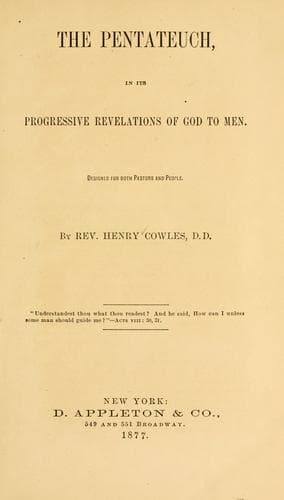
The Pentateuch, in Its Progressive Revelations of God to MenCowles, Henry
Religion
The Pentateuch, in Its Progressive Revelations of God to Men
Cowles, Henry
Bible. Pentateuch -- Criticism, interpretation, etc.
In the Hebrew economy we are struck with the fact that both the
religious and the civil code were enforced chiefly by considerations
and influences, rewards and punishments, coming in from the present
world――not from the future. Let it be supposed that religious duties
were in our age enforced by such motives chiefly――and we should see at
a glance the change that has passed over the world since Moses uttered
the concluding chapters of Deuteronomy. Idolatry, then the head sin
of the ages, was fitly resisted, not only by the civil arm, but by the
most fearful array of civil pains and penalties. The capital sins of
Christendom are now of quite other sort; and the motives to repentance
come appropriately from the other worlds yet before us and not from
this. It may be difficult for us to realize how stern the necessity
was that God should in the earlier ages govern the world, and not least
his own people, by motives from the visible and not from the invisible
world――from earth and time and the present life, and not from the
eternal, the future and yet unseen state.
[This subject will receive further attention near the close of this
volume.]
VII. _The principles and usages of the Hebrew code in respect
to war_; with some notice of the _war-edict_ for the
extirpation of the Canaanites.
By their constitution the war-power was with God. The power and the
right to declare war rested in him alone. He forbade them to make
war on Edom; he commanded them to exterminate Amalek and the devoted
nations of Canaan, and to “vex the Midianites and smite them”. (As
to Edom, see Deut. 2: 5; as to Amalek, Ex. 17: 8, 14, 16 and Deut.
25: 17–19; as to the Midianites, Num. 25: 17, 18, and 31:).――――Their
rulers were expected to bring the question before the Lord――Shall I in
this case go up to battle, or shall I forbear? (Judg. 1: 1, and 20: 18,
23, 28).――――Any one tribe might go out to war alone, or might call in
the aid of another or of all:――a fact which shows that the tribes were
confederated rather than united and consolidated. On great occasions,
of common danger, all the tribes associated together, and, with certain
specified exceptions, every man able for war was required to go. The
exceptions are given (Deut. 20: 5–8); viz. the man who had built a
house, but had not dedicated it; he who had planted a vineyard but had
not eaten of its fruits; he who had betrothed a wife, yet had not taken
her; and finally, every fearful and faint-hearted man;――_i. e._ all
who had special attractions homeward which might tempt them to desert
the ranks, and they whose timid hearts made them worthless and might
be contagious:――in the words of the statute, “Lest his brother’s heart
faint as well as his heart.” Personal heroism was of prime account――a
heroism inspired by faith in Israel’s God. The history every-where
shows that such armies, fired with religious enthusiasm, strong by
Public-domain text, read in full here on John Shaqi.
Reviews
Reviews
No reviews yet
Be the first to share your thoughts on this work.
Elsewhere in the archive
Join the Discussion
Join the discussion
Sign in to leave a comment or review.
Sign InorCreate an account