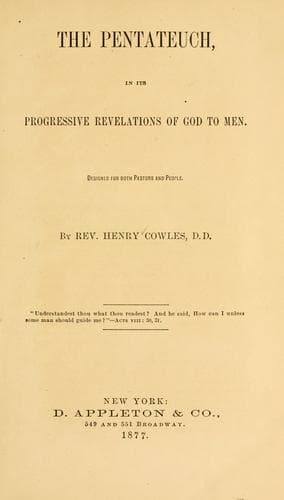
The Pentateuch, in Its Progressive Revelations of God to MenCowles, Henry
Religion
The Pentateuch, in Its Progressive Revelations of God to Men
Cowles, Henry
Bible. Pentateuch -- Criticism, interpretation, etc.
In practice certain crimes against the religious law were enforced
by the state. Idolatry was a state offense, punishable as other state
crimes. So of perjury and blasphemy. (Deut. 19: 16–19.)――――It was due
to the common relations of church and state that to a great extent the
religious orders were civil judges. In the absence of a king or other
chief executive, the High Priest seems to have held that function.
(See Deut. 17: 12 and 2 Chron. 19: 8–11). The subordinate judges were
largely taken from the priests and Levites (Deut. 21: 5, and 33: 10).
Since the system provided for an ultimate appeal to God, extreme cases
were taken up for the sake of such appeal to the one place which was
for the time the seat of God’s special manifestations to his people
(Deut. 17: 8–13, and 19: 17).
The wisdom of this joint action of the civil law with the religious
admits in their case of no question. It may suffice to refer in proof
to the omnipresent power of idolatry through all the ages from Moses to
the captivity, to show the vital need of the civil arm to sustain the
true worship of God and save the nation. On the other hand the state
was the stronger for her religious institutions. The great religious
festivals, bringing the masses of the male population from every
tribe three times a year for a sacred week of communion must have been
of priceless value in sustaining the national unity and a national
patriotism. Jeroboam was sharp enough to see that the calves at Bethel
and Dan must take the place of the festivals at Jerusalem, or his
kingdom would melt away from under him, and his people give their civil
fealty as well as their religious homage at the old center. Hezekiah
would have brought the ten tribes back if he could have drawn their
people in a body to the great Passover, as he sought to do.――――Hence
it is quite safe to say that the state was the stronger for the
national religion, and their religion the stronger for the aid of the
state.――――Yet let none rush to the inference that such mutual relations
of church and state are therefore wise and useful in the Christian
age of the world. The providences of God shut off from the primitive
church the possibility of such union and shut up Christianity to make
her first great conquests under the sturdy opposition of the greatest
civil power of the age. Experience has long since disproved the
inference above referred to. The cases are too dissimilar to admit of
any logical reasoning from that age to this.
Public-domain text, read in full here on John Shaqi.
Reviews
Reviews
No reviews yet
Be the first to share your thoughts on this work.
Elsewhere in the archive
Join the Discussion
Join the discussion
Sign in to leave a comment or review.
Sign InorCreate an account