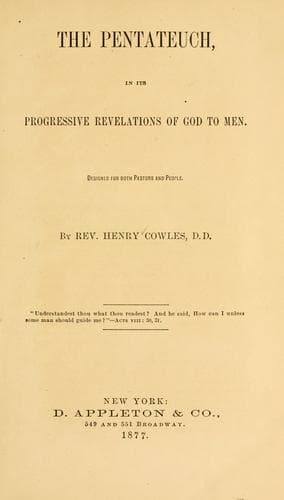
The Pentateuch, in Its Progressive Revelations of God to MenCowles, Henry
Religion
The Pentateuch, in Its Progressive Revelations of God to Men
Cowles, Henry
Bible. Pentateuch -- Criticism, interpretation, etc.
4. The great conflict of those early ages between God and Satan was
fought on the point of idolatry――the real question being whether God or
the devil should have the worship of men; whether the supremacy and the
moral right to rule the world are with God or with Satan. This being
the great conflict of the ages, it should not surprise us that God
should let Israel’s land of promise be in a sort the battle-ground, and
should bring into play the physical force of arms and let his covenant
people come into the fight hand to hand against the hosts of his foes.
This arrangement gave scope for his own hand in various providential
agencies――thunder, hail-storm, the day prolonged miraculously; panics
often smiting the hearts of his enemies, and victories that witnessed
visibly to Jehovah’s present hand. In an age when men were waiting
for God to manifest himself visibly and tangibly; when their spiritual
perceptions were but dim, and when of necessity the first step in the
process of revealing God to men demanded an appeal to the senses, it
was certainly no mistake in wisdom for God to suffer this great fight
to take on visible form and stand out palpably before human eyes. In
the result God made it unmistakably manifest that his soul abhorred
such unnatural and horrid crimes as those of the men of Canaan, and
also that he had both the power and the will to inflict on them the
extremest and most fearful judgments.
CHAPTER XVII.
THE CIVIL INSTITUTES OF MOSES; OR THE HEBREW CODE OF CIVIL LAW.
IN scripture phrase, the code is most often called “The statutes and
the judgments”――the “commandments and precepts” which the Lord gave by
Moses (Deut. 6: 1 and Ex. 21: 1).
I approach this subject with a feeling of regret that the necessary
limits of this volume forbid any attempt to make my presentation of
this topic exhaustive. The utmost I can do within the limits prescribed
is to give an outline rather than a full development of this code.
I shall aim to make this outline full enough to show the _steps and
stages of progress_ in the science of legislation which are obvious in
these “statutes and judgments.”
I must first call attention to certain points of a general nature, most
of which will need only a brief statement.
1. This code of laws was _given to the Hebrews by God himself, through
the hand of Moses_. For the sake of brevity and to distinguish it from
other codes we may speak of it as the code of Moses and may speak of
Moses as the Hebrew lawgiver; yet let it be said once for all that we
recognize no authority――no authorship other than that of God himself.
2. This code was built upon the moral law of Sinai――the ten
commandments. It simply expands and applies the general principles
expressed or implied in that summary.
Public-domain text, read in full here on John Shaqi.
Reviews
Reviews
No reviews yet
Be the first to share your thoughts on this work.
Elsewhere in the archive
Join the Discussion
Join the discussion
Sign in to leave a comment or review.
Sign InorCreate an account