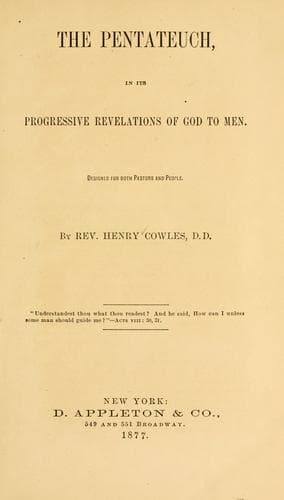
The Pentateuch, in Its Progressive Revelations of God to MenCowles, Henry
Religion
The Pentateuch, in Its Progressive Revelations of God to Men
Cowles, Henry
Bible. Pentateuch -- Criticism, interpretation, etc.
3. It was framed with the purpose of reaching the highest moral
standard practicable in the circumstances of the people――the highest
which it was possible to enforce. This doctrine assumes that any
special statute which is so far above the moral status of the people
as to be practically inoperative and void may be for this very reason
an evil rather than a good inasmuch as it may break down rather than
build up the law-abiding spirit of the people. Consequently the best
statute for any given people may be the best that can be in the main
enforced――the best which they can be brought up to respect and obey.
Hence it may happen that some of the statutes in the best practicable
system will be only second best――_i. e._ not theoretically perfect,
but only the best practically for the circumstances. We may illustrate
this by the law of divorce, as to which Jesus himself remarks that
Moses “because of the hardness of your hearts suffered you to put
away your wives, but from the beginning it was not so” (Mat. 19: 8).
The provisions for an easy divorce were a concession to a sadly low
morality among the people――the best under the circumstances――the
best that could be made operative with that people, but by no means
theoretically perfect.――――The reader will take note that we had
no occasion to apply this principle to the moral law of the ten
commandments, nor indeed to the underlying principles of this code
of “statutes and judgments,” but only to some of its practical
applications of these principles.
4. It is an inference from our last-named point that this code must
needs _take the people as they were_; must have regard to existing
usages, to the common law under which they had been living, and perhaps
must be compelled to tolerate some undesirable usages until better
principles could be inculcated and a higher moral tone of public
sentiment could be established. Illustrations of this principle appear
in the prevalent system of servitude, and in polygamy.
5. Another inference from the point above made is that this code
can not be held responsible for what was in existence before its
promulgation; _e. g._ personal slavery. It can be held responsible
only for doing the best that could be done with such a people――a people
so educated, accustomed to such usages and trained in such ideas.
6. That this code, though given by the Lord himself, was not
theoretically perfect but only the best practicable, is obvious from
the fact that it was from time to time modified. Cases of this appear
in the law respecting the six years’ emancipation of Hebrew servants
(compare Ex. 21: 2–7 with Deut. 15: 12–17); the taking of pledges from
the poor for the payment of debts: (compare Ex. 22: 26 with Deut. 24:
6, 10–15). See also the law of inheritance in a family consisting of
daughters only (Num. 36).
Public-domain text, read in full here on John Shaqi.
Reviews
Reviews
No reviews yet
Be the first to share your thoughts on this work.
Elsewhere in the archive
Join the Discussion
Join the discussion
Sign in to leave a comment or review.
Sign InorCreate an account